SlideServe
Menu
Préférences
© SlideServe · v2026

Precision Cosmology Using High-Redshift QSOs: Insights from the LBL Summer Program 2005

damali avatar
20 diapositives · 348 Views · Aug 10, 2014

This study explores the mean flux and continuum fitting of the Lyman-alpha forest in high-redshift quasars (QSOs) from the LBL Summer Program 2005. It discusses the probability of transmission and scattering, and delineates modern measurement techniques, including Direct Continuum Fitting (DCF) and Continuum Extrapolation (CE). It highlights the challenges and advantages of using the flux probability distribution (PDF) for accurate estimations. Key questions regarding biases in QSO estimates and the contribution of high column systems to metal content are posed for discussion.
Precision Cosmology Using High-Redshift QSOs: Insights from the LBL Summer Program 2005 - slide 1
01 / 20Precision Cosmology Using High-Redshift QSOs: Insights from the LBL Summer Program 2005
1 / 17

Télécharger la présentation

Precision Cosmology Using High-Redshift QSOs: Insights from the LBL Summer Program 2005
Une image / un lien ci-dessous est fourni (tel quel) pour télécharger la présentation

Politique de téléchargement : le contenu du site vous est fourni TEL QUEL pour votre information et votre usage personnel ; il ne peut être vendu, concédé sous licence ni partagé sur d’autres sites sans l’accord de son auteur.Le contenu vous est fourni TEL QUEL, pour votre information et votre usage personnel uniquement. Téléchargez la présentation en cliquant sur ce lien. Lors du téléchargement, si vous ne parvenez pas à télécharger une présentation, l’éditeur a peut-être supprimé le fichier de son serveur.Pendant le téléchargement, si vous ne parvenez pas à obtenir une présentation, le fichier a peut-être été supprimé par l’éditeur.

F I N

Plus de contenu associé

Transcription de la présentation
  1. Precision Cosmology with LBL Summer Program 2005

  2. Another classic high-z QSO with Lyman-a and metal lines Rauch, Sargent & Barlow LBL Summer Program 2005

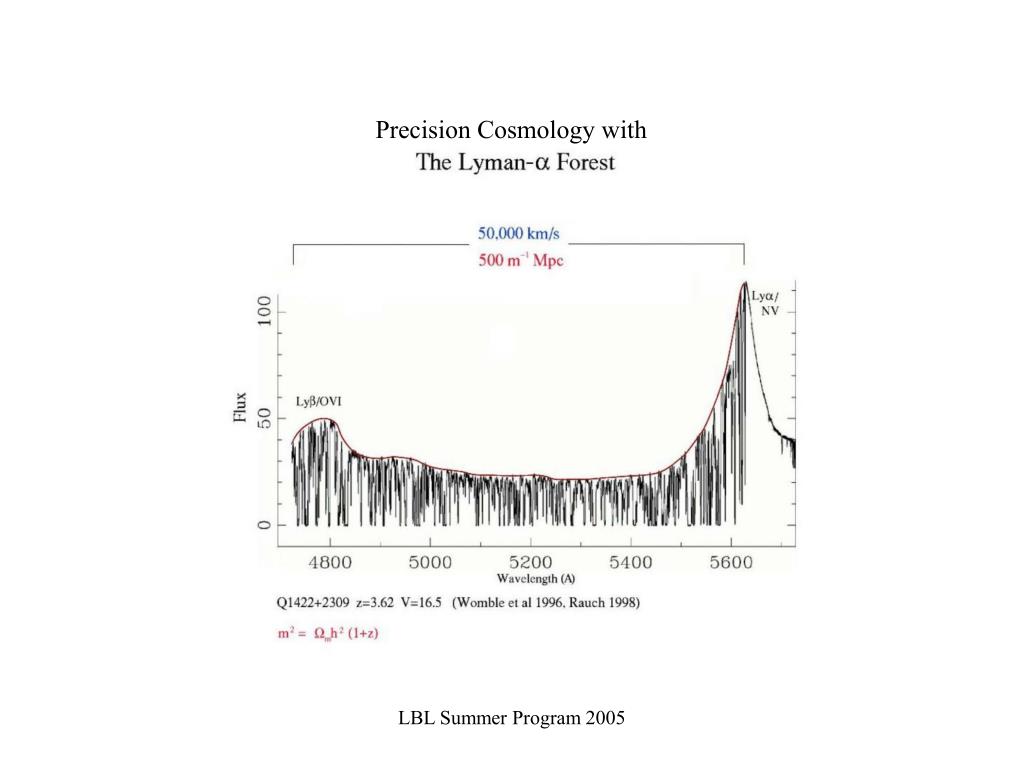
  3. Mean Flux and Continuum Fitting of the z > 2 Lyman-a Forest • Probability of Transmission: <F> = <Observed Flux / QSO Continuum> • Probability of Scattering from Lyman-a: DA = 1 - <F> between 1070-1150 • Long history of measurements, first direct observable of the forest • Modern measurements use 2 techniques: • Direct Continuum Fitting (DCF) to high resolution, high S/N echelle spectra. • e.g. Kirkman et al. 2005, Kim et al. 2001, McDonald et al. 2000 • Requires exhaustive treatment of individual spectra • Currently limited to 10s of lines of sight per redshift bin • Errors in DA at the 5% level • Continuum Extrapolation (CE) to large samples of lower resolution samples • E.g. Press, Rybiki, Schneider; Bernardi et al. 2003 • Requires well fluxed QSO samples, and a motivated model of continuum. • Up to 100s of lines of sight, potential precision of 1% LBL Summer Program 2005

  4. Bernardi et al 2003 LBL Summer Program 2005

  5. LBL Summer Program 2005

  6. All measurements of <F>, DA depend on comparison to simulations… • So let’s use the distribution of flux (PDF) as well as the mean, as suggested by Lidz. Et al 2005 • Advantages: • Does not require absolute continuum determination • Trend removal (Croft et al. 98, Hui et al. 01) can be done on QSO by QSO basis. One does not require composite, nor complicated PCA procedures with large training samples. • Disadvantages: • The observed PDF depends sensitvely to resolution and noise • The PDF bins are highly correlated when normalized by trend removal. • A correct model of the forest should agree with both the mean flux as well as the PDF LBL Summer Program 2005

  7. LBL Summer Program 2005

  8. LBL Summer Program 2005

  9. Lidz et al. 2005 LBL Summer Program 2005

  10. K K LBL Summer Program 2005

  11. Some possible questions for discussion: • Can QSO lines of sight yield “unbiased” estimates of <F>? • Do high column systems contribute excess metals beyond the average dN/dz? • Is it possible to reconcile the current set of available measurements? • Metals and high column systems are significant contributions • What is the ultimate goal in precision for DA: is 1% attainable? • How should we combine constraints from high and low resolution samples? LBL Summer Program 2005

  12. LBL Summer Program 2005

  13. Correlation function of SDSS LRGs Eisenstein et al. 2005 LBL Summer Program 2005

  14. Dv z LBL Summer Program 2005

  15. LBL Summer Program 2005

  16. First attempt with DR3 QSOs, z > 2.7 LBL Summer Program 2005

  17. S2 x Comoving distance (Mpc/h) LBL Summer Program 2005

  18. Jackknife estimates of 1-sigma error LBL Summer Program 2005

  19. From Rupert’s simulation, 1000 LOS LBL Summer Program 2005

  20. 2d image of flux correlation in velocity/redshift z 100 +- 5 Mpc/h 4.0 3.0 2.3 0 2200 10,000 17,000 Velocity separation (km/s) LBL Summer Program 2005