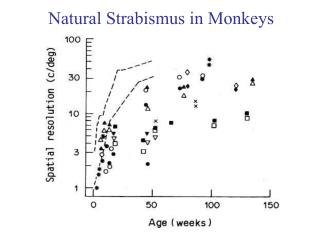
Natural Strabismus in Monkeys
100 likes | 256 Vues
This study explores the mechanisms of visual plasticity in monkeys, focusing on strabismus and its impact on grating acuity in children. It highlights the critical period for binocularity, examining the tilt aftereffect and its implications for understanding visual development. Drawing on Hebb's postulate regarding synaptic efficacy, we investigate how repeated neural activity enhances visual processing. The research provides insights into how visual experiences shape neural connections in the cortex, contributing to our understanding of visual disorders and their treatment.


Natural Strabismus in Monkeys
E N D
Presentation Transcript
Critical Period for Binocularity (tilt aftereffect)
Psychology 3680 Mechanisms of Visual Plasticity
Hebb’s Postulate: “When an axon of cell A is near enough to excite cell B and repeatedly or persistently takes part in firing it, some growth process or metabolic change takes place in one or both cells such that A’s efficiency, as one of the cells firing B, is increased”.