Download

1 / 22
340 likes | 466 Vues
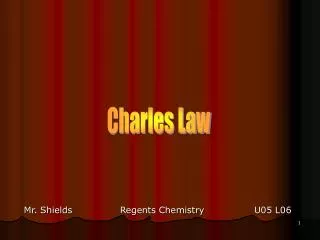
Explore Charles' Law, how gases behave with temperature changes, and the relationship between volume and temperature. Learn about hot air balloons, Charles' experiments, graphing data, and solving problems. Understand direct relationships and extrapolating data.

E N D
Temperature Changes & Matter • Solids & Liquids expand and contract as temperature changes. • Change is usually v. small. • Gases show large volume changes with temperature changes. • What usually happens to V as T ?
Jacques Charles Balloonist. 1787 did expts on how volume of gases depends on temperature.
Relationship between V and T Pressure & amount are constant. At high temperature, the gas particles move faster and collide with the walls more often. Pressure is constant, so volume has to increase.
Charles’ Law • Tiger Graphic
Linear Relationship • Plot Volume vs. C and you get a straight line. • The relationship between Volume and C is linear. • The equation of a line is: Y = mX + b.
Charles extrapolated the graph to 0 volume. At 0 mL, the X-intercept is -273 C.
Hints of Kelvin scale • Charles extrapolated his data to see the temperature at which the volume was 0. • 1st indication that the temperature -273 C might have a fundamental meaning. • Why did Charles have to extrapolate his lines in this temperature range instead of taking data?
Plot Volume vs. Kelvin Temp. • Get a straight line that passes through the origin. • The relationship between the variables is direct. • Y = mX or Y/X = m.
Charles’ Law: Verbal • The volume of a gas at constant pressure varies directly with its absolute temperature.
Charles’ Law: Graphically • Plot Volume vs. Kelvin Temperature • Straight line that passes through the origin. • V = kT or V = k T
Charles’ Law: V = kT or V/T = k. Direct relationship: linear & passes through origin Boyle’s Law: PV = k Inverse relationship. hyperbola Compare Charles’ & Boyle’s Laws
Charles’ Law: Problems V1 = V2 T1 T2 Given any 3 variables, you can find the 4th.
Problem 1 • 150 mL of a gas at constant pressure. • Temperature increases from 20C to 40C. • What is the new volume? • Step 1: Convert T1 and T2 to Kelvin scale. • Step 2: Rearrange equation: V1 = V2 becomes V1T2 = V2 T1 T2 T1 • Step 3: Substitute and solve: 150 mL X 313 K 293 K = 160 mL