Understanding Computers: Their Importance, Components, and Evolution
Computers play an essential role in modern society, operating as electronic devices that process data through stored instructions. This introduction covers their significance, defining features, historical development, and core components. Key milestones in computing history, from the Jacquard Loom to today’s microprocessors, highlight technological evolution. Various computer types are explored, including personal computers, mobile devices, and supercomputers. Additionally, the relationship between hardware and software, as well as the implications of internet technology, privacy, and security, will be discussed.

Understanding Computers: Their Importance, Components, and Evolution
E N D
Presentation Transcript
Are Computers Important? OF COURSE!
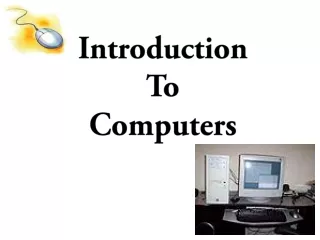
So What is a Computer? A computer is an electronic device, operating under the control of instructions stored in its memory
What is a Computer? Can be programmed Carries out a set of arithmetic or logical operators
History 1801 - Jacquard Loom 1830 – Charles Babbage George Stibitz - father of the modern digital computer. 1937, Stibitz invented and built a relay-based calculator using binary circuits 1936, Alan Turing regarded as father of computer science
History cont. • Punch-cards • Vacuum Tubes • Transistor based • Semiconductors • Microprocessors
The Components of a Computer • Input – Allows users to enter data or instructions into a computer • Output – Hardware that conveys information • SystemUnit – Case that contains the electronic components • Storage Device – Device that holds data, information, and instructions • Communication Device – Enables a computer to send and receive data, instructions, and information to and from one or more computers or mobile devices
Hardware and Software Hardware: electric, electronic, and mechanical components Software: also called a program, tells the computer what tasks to perform and how to perform them
Types of Computers Personal Computers Mobile Computers and Mobile Devices Game Consoles Servers Mainframes Supercomputers Embedded Computers
Embedded Computers • A special purpose computer that functions as a component of a larger product • Calculators • ATM’s • Thermostats • Cameras • Printers • Etc.
Topics We’ll Get To Internet, World Wide Web Input Devices Output Devices Computer Hardware Computer Software Storage Operating Systems Special Topics – Piracy, Censorship, Privacy, Viruses, etc.