Photosynthesis: Harnessing Sunlight for Life's Energy Needs
170 likes | 272 Vues
Living organisms rely on energy for survival, sourced primarily from the sun through food. Autotrophs like plants produce their food using sunlight energy, while heterotrophs like animals obtain energy from consumed foods. ATP, a critical cellular energy compound, powers various processes like active transport and muscle contraction. Photosynthesis, the process by which plants convert sunlight into high-energy carbohydrates and oxygen, is essential for life. Chlorophyll, the main pigment in plants, absorbs light energy to drive photosynthesis. This intricate process occurs in chloroplasts' thylakoid membranes, culminating in the production of sugars through light-dependent and light-independent reactions. Understanding photosynthesis illuminates the interconnectedness of life forms in harnessing energy from the sun.


Photosynthesis: Harnessing Sunlight for Life's Energy Needs
E N D
Presentation Transcript
Energy and Life • Living things need energy to survive. • This energy comes from food. The energy in most food comes from the sun.
Autotrophs and Heterotrophs • Plants and some other types of organisms are able to use light energy from the sun to produce food. • Autotrophs • Make their own food • plants • Heterotrophs • Obtain energy from the foods they consume • animals
Chemical Energy and ATP • Energy comes in many forms including light, heat, and electricity. • Energy can be stored in chemical compounds. • An important chemical compound that cells use to store and release energy is adenosine triphosphate, abbreviated ATP. • ATP is used by all types of cells as their basic energy source.
ATP • ATP consists of: • adenine • ribose (a 5-carbon sugar) • 3 phosphate groups Phosphate groups adenine Sugar
ATP and Energy • Releasing Energy • Energy stored in ATP is released by breaking the chemical bond between the second and third phosphates.
Role of ATP • The energy from ATP is needed for many cellular activities, including active transport across cell membranes, protein synthesis and muscle contraction.
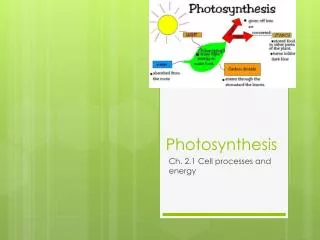
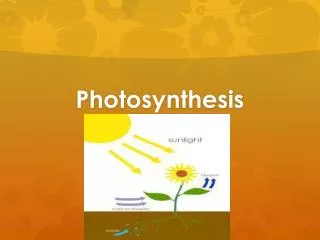
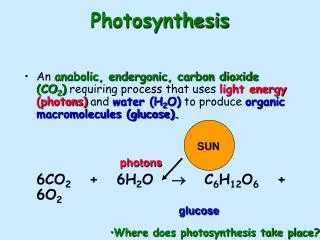
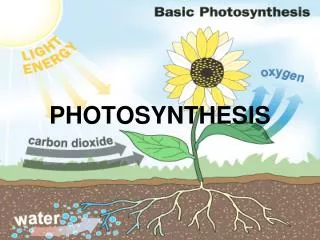
Photosynthesis • Photosynthesis is the process in which green plants use the energy of sunlight to convert water and carbon dioxide into high-energy carbohydrates and oxygen.
Photosynthesis • The equation for photosynthesis is: Light energy+6CO2 + 6H2O C6H12O6 + 6O2 Light energy +carbon dioxide + water sugars + oxygen • Photosynthesis uses the energy of sunlight to convert water and carbon dioxide into high-energy sugars and oxygen.
Light and Pigments • In addition to water and carbon dioxide, photosynthesis requires light and chlorophyll. • Plants gather the sun's energy with light-absorbing molecules called pigments. • The main pigment in plants is chlorophyll. • There are two main types of chlorophyll: • chlorophyll a • chlorophyll b
Light and pigments • Light is a form of energy, so any compound that absorbs light also absorbs energy from that light. • When chlorophyll absorbs light, much of the energy is transferred directly to electrons in the chlorophyll molecule, raising the energy levels of these electrons. • These high-energy electrons are what make photosynthesis work.
Chloroplast • Site of photosynthesis • Chloroplasts contain thylakoids—saclike photosynthetic membranes. • A stack of thylakoids is called a granum Granum
Reactions of Photosynthesis • Light-Dependent Reactions • The light-dependent reactions require light. • The light-dependent reactions produce oxygen gas and convert ADP and NADP+ into the energy carriers ATP and NADPH. • NADP+ is an electron carrier that transports high energy electrons from the light reaction to the Calvin Cycle
Reaction of Photosynthesis • The Calvin cycle uses ATP and NADPH from the light-dependent reactions to produce high-energy sugars. • Because the Calvin cycle does not require light, these reactions are also called the light-independent reactions.
Reaction of Photosynthesis • The two sets of photosynthetic reactions work together. • The light-dependent reactions trap sunlight energy in chemical form. • The light-independent reactions use that chemical energy to produce stable, high-energy sugars from carbon dioxide and water.