Understanding the Properties of Parallelograms and Their Theorems
This educational resource explores key properties and theorems related to parallelograms, particularly focusing on quadrilaterals such as PQRS and FGHJ. It covers essential aspects including congruent opposite sides, angles, and supplementary consecutive angles. Theorems 5.18 to 5.21 are examined with examples that demonstrate how to utilize these properties in problem-solving, such as finding unknown side lengths and angle measures. This guide is beneficial for students studying geometry, as it reinforces understanding through practical applications.

Understanding the Properties of Parallelograms and Their Theorems
E N D
Presentation Transcript
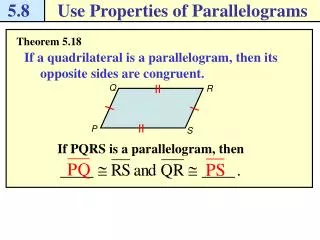
5.8 Use Properties of Parallelograms Q R P S Theorem 5.18 If a quadrilateral is a parallelogram, then its opposite sides are congruent. If PQRS is a parallelogram, then
5.8 Use Properties of Parallelograms Q R P S Theorem 5.19 If a quadrilateral is a parallelogram, then its opposite angles are congruent. If PQRS is a parallelogram, then
5.8 Use Properties of Parallelograms G F H J Opposite sides of a are . By Theorem 5.19, In FGHJ, x = ___ and y = _____. Use properties of parallelograms Example 1 Find the value of x and y. Solution FGHJ is a parallelogram by the definition of a parallelogram. Use Theorem 5.18 to find the value of x. Substitute x + 6 for FG and __ for ___. Subtract 6 from both sides.
5.8 Use Properties of Parallelograms Q R P S Theorem 5.20 If a quadrilateral is a parallelogram, then its consecutive angles are _______________. supplementary If PQRS is a parallelogram, then
5.8 Use Properties of Parallelograms A B D C By Theorem 5.20, the consecutive angle pairs in ABCD are ______________. Use properties of a parallelogram Example 2 Gates As shown, a gate contains several parallelograms. Solution supplementary
5.8 Use Properties of Parallelograms Checkpoint. Find the indicated measure in LMN shown at the right. L M N K • x By Theorem 5.18, opposite sides are congruent.
5.8 Use Properties of Parallelograms Checkpoint. Find the indicated measure in LMN shown at the right. L M N K • y By Theorem 5.19, opposite angles are congruent.
5.8 Use Properties of Parallelograms Checkpoint. Find the indicated measure in LMN shown at the right. L M N K • z By Theorem 5.20, consecutive angles are supplementary.
5.8 Use Properties of Parallelograms Q R P S Theorem 5.21 If a quadrilateral is a parallelogram, then its diagonals _________ each other. bisect
5.8 Use Properties of Parallelograms U T W V S By Theorem 5.21, the diagonals of a parallelogram _______ each other. So, W is the _________ of the diagonals TV and SU. The diagonals of STUV intersect at point W. Find the coordinates of W. Find the intersection of diagonals Example 3 Solution bisect midpoint Midpoint Formula Use the _____________________. Coordinates of the midpoint W of
5.8 Use Properties of Parallelograms • The diagonals of VWXY intersect at point Z. Find the coordinates of Z X W Z V Y By Theorem 5.21, the diagonals of a parallelogram bisect each other. So, Z is the midpoint of the diagonals WY and VX. Checkpoint. Complete the following exercises.
5.8 Use Properties of Parallelograms • Given that FGHJ is a parallelogram, find MH and FH. G F M H J By Theorem 5.21, the diagonals of a parallelogram bisect each other. So, M is the midpoint of the diagonal FH. Checkpoint. Complete the following exercises.
5.8 Use Properties of Parallelograms Pg. 318, 5.8 #2-34 even