
Electrocardiography
E N D
Presentation Transcript
By Michelle Ramsey Electrocardiography
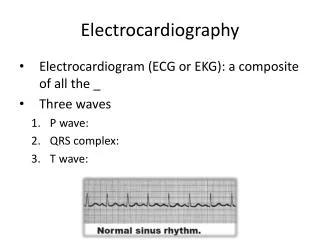
What is it? • A diagnostic device • Shows the hearts electrical activity • Noninvasive • Shows the hearts beating rate • Heart beat regularity
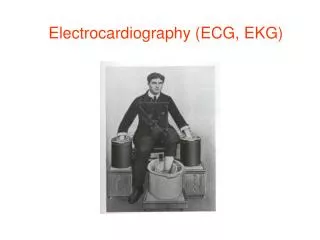
History • Early 1900s • Einthoven • Submerging limbs into salt water • Nobel Peace Prize
How It Works • 3-12 pads placed on skin • Leads connect the patient to the ECG machine • Records electrical impulses • Results printed out for a hardcopy and displayed on the devices screen
Leads • Connect the patient to the ECG machine • Range from about 3-12 • May be placed commonly on the right/left arm, right/left leg, intercostal space, mid-clavicular line, mid-axillary line, anterior axillary line
Why? • Cardiac murmurs • Seizures • Monitoring during surgery • Monitoring critically ill patients • Slow/fast heart rates • Detect past and future heart attacks • Irregular heart rhythm
References • [1] A Basic Overview <http://voices.yahoo.com/a-basic-overview-ecg-waveform-1040017.html>. • [2] A Normal ECG <http://www.learntheheart.com/NormalEKG.html>. • [3] Rhythm Recognition <http://learntech.uwe.ac.uk/manacuteill/Default.aspx?pageid=1902> • [4] How An ECG Reads Electrical Activity <http://www.drsegal.com/medstud/ecg/howecg.htm> • [5] ECG At Your Healthcare Provider http://www.umm.edu/ency/article/003868.htm • [6] iPhone and ECG <http://techcrunch.com/2010/12/30/iphonecg-iphone-heart- monitor/>