Download
1 / 18
180 likes | 321 Vues
This study employs a computer algebra approach to sensitivity analysis of the TRP operon in E. coli, utilizing ordinary and partial differential equations to model mass action kinetics and concentration sensitivities. We solve the resulting large system of equations using computer algebra systems (CAS) like Maple and MATLAB. By investigating how parameter changes affect system dynamics, we derive sensitivity equations for multiple variables and parameters, improving prediction accuracy. Our results reveal key insights into the operon's regulatory mechanisms and establish a basis for future model enhancement.

E N D
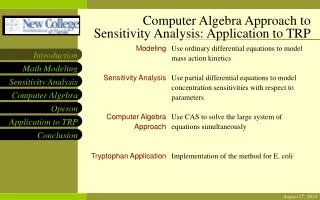
Computer Algebra Approach to Sensitivity Analysis: Application to TRP Modeling Sensitivity Analysis Computer Algebra Approach Tryptophan Application Use ordinary differential equations to model mass action kinetics Use partial differential equations to model concentration sensitivities with respect to parameters Use CAS to solve the large system of equations simultaneously Implementation of the method for E. coli August 27, 2014
Variable Concentrations Constant Parameters Modeling Basics
How do we get Sensitivity equations? Normalized Unitless Sensitivity Score
A Simple Example Recall, and, Then,
Computer Algebra Software Sensitivity Analysis requires a PDE for each variable with respect to each parameter. For m variables and n parameters, this is n(m+1) equations. Maple can do symbolic calculus to find the required PDE’s, building the sensitivity matrix. Matlab can take this matrix, along with the modeling ODE’s, and solve the resulting system numerically.
What is an Operon? A operon is a genetic regulatory network. It is defined by a set of common genes with one operator. The operator is a binding site for a regulatory protein.
What is the TRP Operon? The tryptophan operon in E. Coli is a repressive operon, that shuts down tryptophan production when tryptophan is present in the environment. The presence of tryptophan enables a repressor to bind to the operator, disabling the operon.
CAS Implementation 4 concentrations: Of, Mf, E, T x 24 parameters = 96 sensitivities Maple will find these sensitivities quickly with matrix algebra. 4 concentrations + 96 sensitivities = 100 differential equations Matlab will solve this system simultaneously and print sensitivity scores.
TRP Sensitivities Revealed [T]/k-t Repressor Dissassociation Transcription Termination [T]/b
Correlation to Experimental Results b = .85 b = .9996
Future Work Improve the Model Parameter Estimation Collaborative Work The operon is more complex than the model presented here. For example, there is a time delay in transcription. Parameter values directly effect the numeric solution. Better estimations will give more accurate results. A database of results to check against.
References Dynamic regulation of the tryptophan operon: A modeling study and comparison with experimental data Moises Santillan and Michael C. Mackey (2001) Modeling operon dynamics: the tryptophan and lactose operons as paradigms Michael C. Mackey, Moises Santillan, Necmettin Yildirim (2004)