Cervical Nerve Root Impingement By: Michael Cox
Cervical Nerve Root Impingement By: Michael Cox. Overview . Anatomy of cervical spine and nerve roots Reasons for impingement Signs and symptoms associated with nerve root impingement Acute treatment of injury Rehabilitation Return to play criteria. Anatomy .

Cervical Nerve Root Impingement By: Michael Cox
E N D
Presentation Transcript
Overview Anatomy of cervical spine and nerve roots Reasons for impingement Signs and symptoms associated with nerve root impingement Acute treatment of injury Rehabilitation Return to play criteria
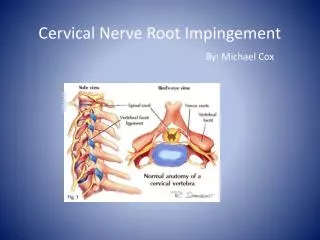
Anatomy • Primary Function: Mobility, support, and protection of spinal canal and neural structures • 7 cervical vertebrae • 8 nerve roots • 6 intervertebral discs • Foramina • Nerve root occupies 25-33% over the foramina space • Lordotic curve • most of lordosis occurs at C1-C2 • Some Biomechanics: • 50% of flexion and extension occurs at occipitoatlantal joint • 50% of rotation occurs at C1-C2
Anatomy • Vertebral Disc • Located between C2-C7 • Composed of annulus fibrosis, which is the outer layer made up of thick fibrous cartilage • Nucleus pulposus is the inner layer which is a water gelatin • Discs serve as shock absorbers and allow the spine to bend
Anatomy • Nerve roots • Myotomes • C1: Cervical flexion • C2: Cervical flexion • C3: Cervical lateral bending • C4: Shoulder elevation • C5: Shoulder Abduction • C6: Elbow Flexion/wrist extension • C7:Elbow extension/wrist flexion • C8: Ulnar deviation/thumb extension • T1: Finger abduction/adduction • Dermatomes • C1: Top of head • C2: Side of face • C3: Down mandible • C4: Lateral neck • C5: lateral upper arm • C6: Lateral forearm to thumb • C7: Middle forearm to 3rd • C8: 5th to medial forearm • T1: Medial upper arm
Anatomy • Muscles • SCM • Splenius muscles • Levator scapula • Scalenes • Upper trapezius
Mechanism for Impingement • This injury can occur from an extension, lateral bending, or rotation mechanism, which causes a narrowing of the neural foramen and results in ipsilateral nerve root injury • Disc herniation can cause the nucleus pulposus to leak into the foramen and cause impingement on the nerve
Signs and Symptoms • Neck and shoulder pain and discomfort that can radiate down the arm • Tingling or numbness along the nerve root involved • Motor weakness in affected nerve root (manual muscle testing) • Depending on reason for impingement certain motions (AROM) can cause pain • Point tenderness is usually located along the lateral and posterior cervical muscles on the affected side • Muscle tenderness and spasm on affected side is usually present
Special Test’s • Deep Tendon Reflexes • Biceps Brachii reflex: C5-C6 • Brachioradialis reflex- C5-C6 • Triceps reflex: C7-C8 • Foraminal Compression Test • Manuel Distraction • Shoulder Abduction Test
Acute Treatment • “A best-evidence synthesis by the Bone and Joint Decade 2000-2010 Task Force on Neck Pain and its Associated Disorders concluded that there is not clear evidence that surgical treatment of cervical radiculopathy provides better long-term outcomes than nonoperative measures.” • Icing • NSAIDS • Rest • Take measures that reduce force compressing the nerve root • Avoiding positions that increase symptoms
Rehabilitation Early Phase • Main goal is reducing symptoms: controlling pain and inflammation • Cervical collar • Restricts motions that cause pain • Patient comfort • Cervical pillow at night can help can help maintain the neck in a neutral position and limit head positions that cause narrowing of the neural foramen • Ice- help reduce muscle spasm and pain • NSAIDS
Rehabilitation Early Phase • Traction- Decreases pressure caused by axial loading • Manuel traction • Mechanical traction • Positional traction • Self administered, body positioning Disc Protrusion- Intermittent traction • Force pulposus back in Impingement- Sustained traction • Removes mechanical pressure on nerve root and allows for inflammation of nerve root to decrease • Reducing adhesions within Dural sleeve by elongating the surrounding structure • Restoring normal slack in the neuromeningeal structures
Rehabilitation Moderate Phase • Goals: • Restoring ROM • Maintaining pain free symptoms • Light strengthening • Criteria for progression • Pain and inflammation have been controlled
Rehabilitation Moderate Phase • Continued Traction • Stretching: • Sustained stretching in all directions • Flexion, extension, lateral bending, rotation • Home stretching exercises • Soft Tissue Mobilizations • Spleni muscles, posterior cervical muscles, scalenes, upper trap, levator scapulae, SCM • AROM exercises • Go until pain then return to neutral • All directions
Rehabilitation Moderate Phase • Joint Mobilizations • Cervical lateral glides in upper limb neurodynamics position • Upper and Midthoracic spine manipulation in supine: • “an association exists between mobility in the thoracic spine and neck/shoulder pain.” • “thoracic manipulation can help increase cervical ROM” • Central PA’s
Rehabilitation Moderate Phase • Strengthening • At this time rehab should focus on isometric strengthening only until full ROM is achieved • Flexion • Extension • Lateral bending • Rotation • Deep flexor strengthening • Scapular muscle strengthening • Rhomboids: rows • Serratus anterior: push up plus • Middle and upper trap: fly’s
Rehabilitation Progressive Phase • Goals: • Maintain ROM • Maintain pain free symptoms • Cervical muscle strengthening • Cervical Stabilization • Nerve root strengthening • Functional Activity • Criteria for progression • Pain free ROM • Diminished inflammation
Rehabilitation Progressive Phase • Strengthening: • Isotonic cervical strengthening • All directions: can be done using a cervical machine, pulley system, or Thera-band • Involved nerve root strengthening • Isotonic motions • Can use either dumbbells, Thera-band, tubing, mechanically
Rehabilitation Progressive Phase • Cervical stabilization • All directions • Hold for 30 sec • 3 sets • PNF Patterns • Functional Activity
Return to Play Criteria • Full pain-free ROM • Full strength and stabilization • No tingling or numbness with ROM • Full cardiovascular endurance
Summary • Cervical nerve root impingement can occur from a herniated disc or from narrowing of the neural foramen • Patient may complain of neck pain and tingling or numbness radiating down the arm • Progression is based on patient symptoms • Pain management is important