Common Damage Mechanisms
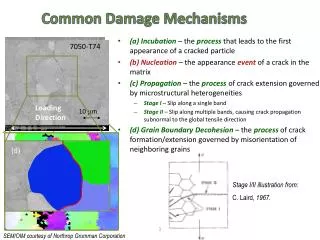
This comprehensive overview examines the common damage mechanisms observed in 7075-T651 aluminum under various loading conditions. We begin by detailing the stages of crack development: incubation, nucleation, and propagation. The process involves slip behavior along bands, leading to crack growth and grain boundary decohesion influenced by neighboring misorientations. Important stages include single band slip and multi-band slip propagation. This information is crucial for engineers and metal specialists focusing on fatigue and fracture mechanics in high-strength alloys.

Common Damage Mechanisms
E N D
Presentation Transcript
Cycle: Cycle: Cycle: Cycle: 0 1 100 3000 7050-T74 10 mm 250 mm Common Damage Mechanisms 7075-T651 Loading Direction • (a) Incubation – the process that leads to the first appearance of a cracked particle • (b) Nucleation – the appearance event of a crack in the matrix • (c) Propagation– the process of crack extension governed by microstructural heterogeneities • Stage I – Slip along a single band • Stage II – Slip along multiple bands, causing crack propagation subnormal to the global tensile direction • (d) Grain Boundary Decohesion– the process of crack formation/extension governed by misorientation of neighboring grains Loading Direction (a) (b) (c) (d) b 10 mm a c Stage I/II illustration from: C. Laird, 1967. SEM/OIM courtesy of Northrop Grumman Corporation