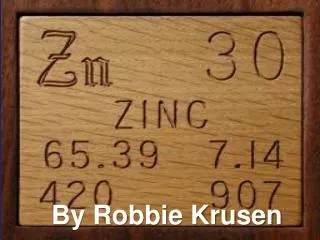
The Importance of Zinc: Structure, History, and Uses of this Essential Element
90 likes | 258 Vues
Zinc, a significant metal with atomic number 30, plays crucial roles in various industries and human health. This presentation outlines the structure of zinc, detailing its atomic composition, including protons, neutrons, and electrons. We trace the history of zinc's discovery by Andreas Marggraf in 1746 and its various applications, from rust protection to its use in die casting for automotive and electrical industries. Additionally, we explore its importance in human growth and how dietary sources can prevent deficiencies. Understanding zinc's significance unveils its everyday impact on our lives.


The Importance of Zinc: Structure, History, and Uses of this Essential Element
E N D
Presentation Transcript
What Are Elements? • Definition: a specific type of atom • I will be presenting the structure, history, and importance of zinc.
Zinc’s Atom P = 30 N = 35 N M L K Shell K – 2 Shell L – 8 Shell M – 18 Shell N - 2
What is the Structure of Zinc? • Nucleus in the center that contains the protons & neutrons • Shells are an invisible path electrons travel around. Zinc has 4 shells • Zinc has 30 protons, 35 neutrons, and 30 electrons • Atomic weight is 65 • Atomic number is 30 • The Symbol for Zinc is ZN
What is the History of Zinc? • Founded in 1746 • Founder is Andreas Marggraf • Discovered by heating calamine with charcoal • Discovered and rediscovered in Europe
Why is Zinc Important? Uses • melting coating, rust protection ,brass, bronze, nickel • die casting which are used by automotive, electrical, and hardware • Found in x-rays, TV screens, fluorescent lights, paints, rubber, cosmetics, pharmaceuticals, floor coverings and plastic • Lastly zinc is important for human growth
Interesting Facts • Very toxic • Roughly 70 cents/lb. in 1990 • Zinc is important for human growth and animals • White spots on your finger nails = not enough Zinc in your body • Major sources of zinc are red meat, poultry, fish, seafood, cereal, and dairy products.
Conclusion I learned…… • A very important metal that has many everyday uses • Bluish – white metal that affects people’s health everyday • Can be burned in the air at high heat and can also be melted at 420 degrees Celsius
Works Consulted "A Periodic Table of the Elements at Los Alamos National Laboratory." Web. 10 Dec. 2010. “Elements." Chemical Elements.com - An Interactive Periodic Table of the Elements. Web. 10 Dec. 2010. "Elements." Current Science. POWER Library. SIRS Discoverer. Web. 10 Dec. 2010. "It's Elemental - The Periodic Table of Elements." Science Education at Jefferson Lab. Web. 10 Dec. 2010. Knapp, Brian J., David Woodroffe, and David A. Hardy. Elements. Danbury, CT: Grolier Educational, 2000. Print. "Periodic Table - Chart of All Chemical Elements." Lenntech. Web. 10 Dec. 2010. “WebElements.” Periodic Table of the Elements. Web. 10 Dec. 2010.












![[PDF] Free Download Blood Of Iax By Robbie MacNiven](https://cdn4.slideserve.com/8018315/slide1-dt.jpg)
![[PDF] Free Download Blood Of Iax By Robbie MacNiven](https://cdn4.slideserve.com/8018502/slide1-dt.jpg)
![[PDF] Free Download Blood Of Iax By Robbie MacNiven](https://cdn4.slideserve.com/8019880/slide1-dt.jpg)
![[PDF] Free Download The Reaping Time By Robbie MacNiven](https://cdn4.slideserve.com/8019919/slide1-dt.jpg)


![[PDF] Free Download Heartwood By Robbie MacNiven](https://cdn5.slideserve.com/9846006/slide1-dt.jpg)
![[PDF] Free Download Infurnace By Robbie MacNiven](https://cdn5.slideserve.com/9846278/slide1-dt.jpg)
![[PDF] Free Download Wolf Trap By Robbie MacNiven](https://cdn5.slideserve.com/9847298/slide1-dt.jpg)