SlideServe
Menu
Préférences
© SlideServe · v2026

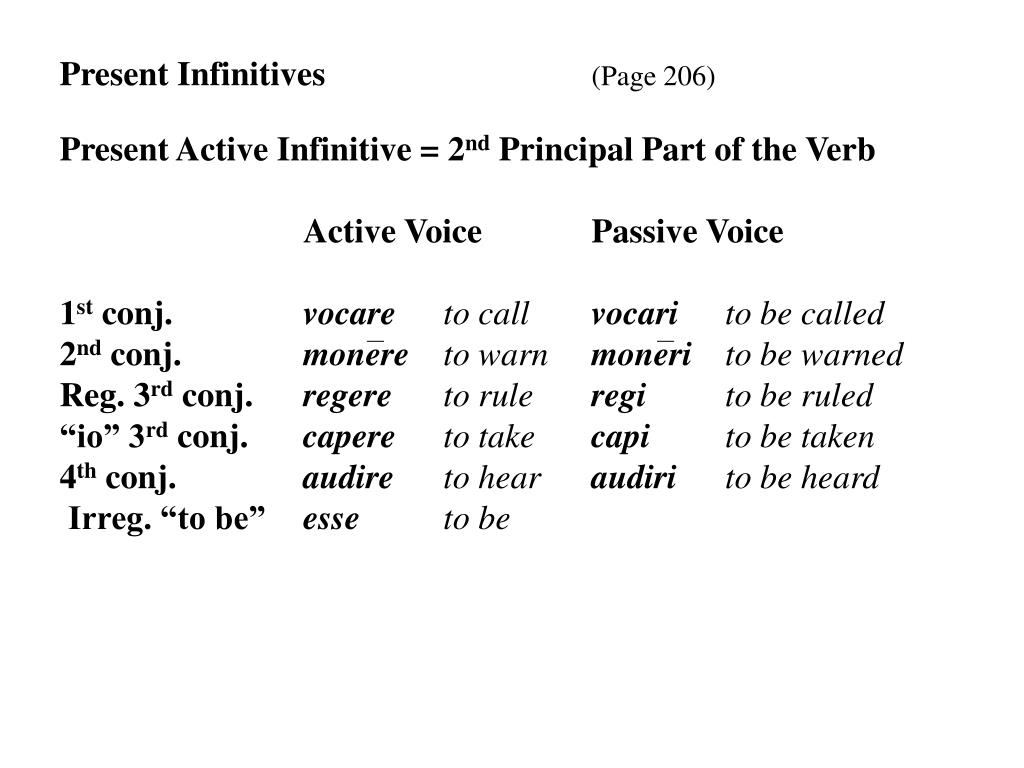
Present Infinitives (Page 206) Present Active Infinitive = 2 nd Principal Part of the Verb

darius-maynard avatar
4 diapositives · 362 Views · Nov 19, 2014

Present Infinitives (Page 206) Present Active Infinitive = 2 nd Principal Part of the Verb Active Voice Passive Voice 1 st conj. vocare to call vocari to be called 2 nd conj. monere to warn moneri to be warned Reg. 3 rd conj. regere to rule regi to be ruled
Present Infinitives		 (Page 206) Present Active Infinitive = 2 nd Principal Part of the Verb - slide 1
01 / 4Present Infinitives (Page 206) Present Active Infinitive = 2 nd Principal Part of the Verb
1 / 17

Télécharger la présentation

Present Infinitives (Page 206) Present Active Infinitive = 2 nd Principal Part of the Verb
Une image / un lien ci-dessous est fourni (tel quel) pour télécharger la présentation

Politique de téléchargement : le contenu du site vous est fourni TEL QUEL pour votre information et votre usage personnel ; il ne peut être vendu, concédé sous licence ni partagé sur d’autres sites sans l’accord de son auteur.Le contenu vous est fourni TEL QUEL, pour votre information et votre usage personnel uniquement. Téléchargez la présentation en cliquant sur ce lien. Lors du téléchargement, si vous ne parvenez pas à télécharger une présentation, l’éditeur a peut-être supprimé le fichier de son serveur.Pendant le téléchargement, si vous ne parvenez pas à obtenir une présentation, le fichier a peut-être été supprimé par l’éditeur.

F I N

Plus de contenu associé

Transcription de la présentation
  1. Present Infinitives (Page 206) Present Active Infinitive = 2nd Principal Part of the Verb Active Voice Passive Voice 1st conj.vocareto callvocarito be called 2nd conj.monereto warnmonerito be warned Reg. 3rd conj.regereto ruleregito be ruled “io” 3rd conj.capereto takecapito be taken 4th conj.audireto hearaudirito be heard Irreg. “to be”esseto be

  2. The Three Uses of the Infinitive 1. Complementary Infinitive (English Word Order = SubjectVerbInfinitive) The man desires to work. Vir laborare desiderat. 2. Subjective Infinitive (Infinitive used as a subject or predicate nominative) It is pleasant to walk. Ambulare est gratum. or Est gratum ambulare. 3. Objective Infinitive (English Word Order = SubjectVerbNoun/PronounInfinitive) The farmer taught the slavesto work. Agricola servoslaborare docuit. (The accusative noun servos in front of the infinitive is called a subject accusative.)

  3. Perfect Active Infinitive (Page 271) In English to have is the indicator of the perfect active infinitive, which is formed by combining to have with the perfect participle: to have + called = to have called. In Latin the perfect active infinitive is formed by adding the indicator -isse to the perfect stem: vocav + isse = vocavisse = to have called Perf. Stem + Infinitive = Form Ending First vocav + isse = vocavisseto have called Second monu + isse = monuisseto have warned Third rex + isse = rexisseto have ruled Third -iocep + isse = cepisseto have taken Fourth audiv + isse = audivisseto have heard

  4. Perfect Passive Infinitive (Page 272) In English to have been is the indicator of the perfect passive infinitive, which is formed by combining to have been with the perfect participle: to have been + called = to have been called. In Latin the perfect passive infinitive is formed by combining the perfect passive participle with esse: vocatus + esse = vocatus esse = to have been called Perf. Pass. Part. + esse = Form First vocatus -a -um + esse = vocatus -a -um esse = to have been called Second monitus -a -um + esse = monitus -a -um esse = to have been warned Third rectus -a -um + esse = rectus -a -um esse = to have been ruled Third -iocaptus -a -um + esse = captus -a -um esse = to have been taken Fourth auditus -a -um + esse = auditus -a -um esse = to have been heard