
SlideServe
Menu
Préférences
© SlideServe · v2026

Galaxy Clusters & Large Scale Structure

darius-tate avatar
62 diapositives · 839 Views · Nov 01, 2014

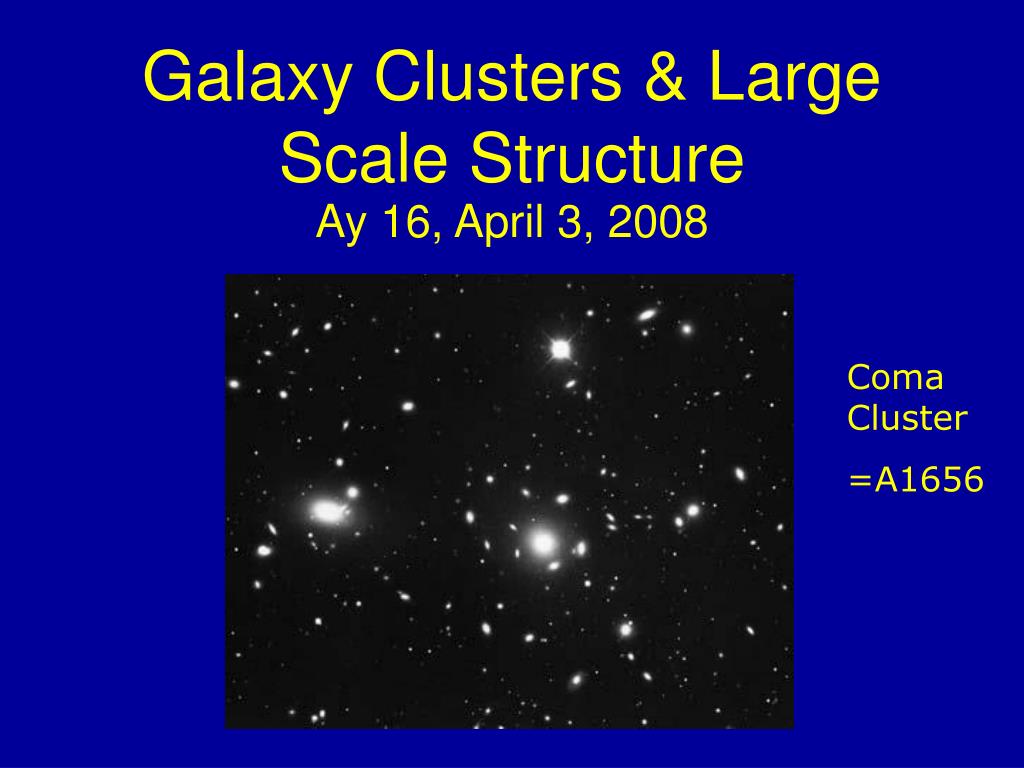
Galaxy Clusters & Large Scale Structure. Coma Cluster =A1656. Ay 16, April 3, 2008. Galaxies Are Not Randomly Distributed in Space. Fundamental discovery (and debate) in the 20th century is that Galaxies cluster. On small scales: Binaries ~100 kpc
Galaxy Clusters & Large Scale Structure - slide 1
01 / 62Galaxy Clusters & Large Scale Structure
1 / 17

Télécharger la présentation

Galaxy Clusters & Large Scale Structure
Une image / un lien ci-dessous est fourni (tel quel) pour télécharger la présentation

Politique de téléchargement : le contenu du site vous est fourni TEL QUEL pour votre information et votre usage personnel ; il ne peut être vendu, concédé sous licence ni partagé sur d’autres sites sans l’accord de son auteur.Le contenu vous est fourni TEL QUEL, pour votre information et votre usage personnel uniquement. Téléchargez la présentation en cliquant sur ce lien. Lors du téléchargement, si vous ne parvenez pas à télécharger une présentation, l’éditeur a peut-être supprimé le fichier de son serveur.Pendant le téléchargement, si vous ne parvenez pas à obtenir une présentation, le fichier a peut-être été supprimé par l’éditeur.

F I N

Plus de contenu associé

Transcription de la présentation
  1. Galaxy Clusters & Large Scale Structure Coma Cluster =A1656 Ay 16, April 3, 2008

  2. Galaxies Are Not Randomly Distributed in Space Fundamental discovery (and debate) in the 20th century is that Galaxies cluster. On small scales: Binaries ~100 kpc intermediate scales: Groups ~1 Mpc larger scales: Clusters few Mpc even larger scales: Superclusters 10’s Mpc largest seen: Voids + Cosmic Web ~50 Mpc

  3. M51 = Whirlpool = NGC 5194+95 NOAO

  4. Seyfert’s Sextet

  5. Stefan’s Quintet

  6. Abell 1689

  7. Coma Cluster

  8. Coma in X-rays

  9. Mass Estimators: 3 πΣσP2 RP • MV= • MP = ΣRi (Vi-VG)2 with fPM =10.2 and γ = 1.5 (Heisler, Tremaine & Bahcall 1985, ApJ 298, 8) 2 G fPM π G (N – γ)

  10. Hydrostatic Equilibrium Abell 2142 in X-rays CXO

  11. Gravitational Lensing

  12. Cluster Mass Estimates Now three techniques agree fairly well for the same clusters -- Galaxy Dynamics, Gas Hydrostatic Equilibrium + Gravitational Lensing masses give a mean M/L of around 300 in blue light (solar units) and 100 in infrared light. This is important for cosmology as it implies (1) that there’s lots of Dark Matter on large scales, and (2) that  matter is ~ 0.25.

  13. Perseus Cluster Shocks in the hot Gas (Fabian+)

  14. Abell 2597 shocks and bubbles

  15. Large Scale Structure The study of the galaxy distribution on large scales started out with maps.

  16. Election ’06 Congressional Districts

  17. Its all in the display: Election ’04 By County R/B By County color range By state scaled by population

  18. Messier’s map: What do you see?

  19. W. Herschel

  20. New General Catalogue + Index Catalogues

  21. Fritz Zwicky et al. CGCG

  22. Zwicky’s Catalog

  23. Early “Modern” Views • Hubble: The Large Scale is “Sensibly Uniform,” one cluster per 50 square degrees. “General Field of galaxies, isolated groups and clusters. versus • Zwicky “Clusters are Common” “cluster cells separated by saddles or minima ... and … not … flatlands”

  24. Statistics of Clustering Many different “statistical” measures. Peebles and Totsuji & Kihara introduced the correlation function -- a measure of the excess probability of finding a galaxy near another galaxy --- in the early 1970’s.

  25. Correlation Functions 2D Angular Correlation Function dP = N [1 + w()] d where N = surface density of galaxies  = angular separation and  = solid angle (area of sky)

  26. 3D Spatial Correlation Function dP = n [ 1 + (r) ] dV where n is now the volume density dV is the volume element and r is some measure of separation e.g. s = [d2 + ((v1 - v2)/H)2 ]1/2

  27. Hubble’s Discovery of Expansion

  28. Redshift Surveys 3747 +/- 20 CfA Survey

  29. 3D Maps of the Local Universe Not much progress until the mid 1970’s! Catalogs existed from Photographic Surveys- 2D only (Zwicky++; Vorontosov-Velyaminov++) In 1972 the largest “complete” galaxy redshift sample had only ~250 galaxies Key was innovations in detector technology: computers + digital detectors sensitive radio receivers

  30. Larsonwasn’t quite right…

  31. The Little Telescope that could. Tillinghast 1.5-m

  32. The Z Machine Davis, Tonry, Latham & Huchra Based on a concept by Shectman & Gunn

  33. Spectral features in galaxies

  34. CfA2 Slice

  35. 1985 CfA 2 deLapparent, Geller & Huchra

  36. CfA2 1995

  37. 6dF Fiber Positioner, SRC Schmidt, Coonabarabran

  38. Great Wall LSC We are here Pisces-Perseus KS < 11.25

  39. M. Westover

  40. Magenta V < 1000 km/s • Blue 1000 < V < 2000 km/s • Green 2000 < V < 3000 km/s

  41. Red3000 < v < 4000 Red 3000 < v < 4000 Blue 4000< v < 5000 Green 5000 < v < 6000

  42. Red 6000 < v < 7000 Blue 7000 < v < 8000 Green 8000 < v < 9000