Parameterizing Tidal Mixing at Tall Steep Isolated Ridges: Energy Dissipation and Wave Dynamics
30 likes | 166 Vues
This study investigates tidal mixing at tall, steep isolated ridges, focusing on the generation of transient internal waves. Utilizing MITgcm simulations with specified tidal forcing, the research reveals that steep, tall topography leads to the formation of jump-like lee waves, which overturn when the flow relaxes, resulting in local mixing. The paper discusses the energy dissipation processes associated with these waves, characterized by vertical wavenumber and mode numbers, emphasizing the impact of topography and tidal velocities on local mixing dynamics.


Parameterizing Tidal Mixing at Tall Steep Isolated Ridges: Energy Dissipation and Wave Dynamics
E N D
Presentation Transcript
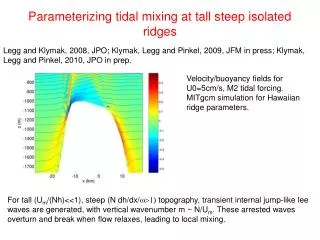
Parameterizing tidal mixing at tall steep isolated ridges Legg and Klymak, 2008, JPO; Klymak, Legg and Pinkel, 2009, JFM in press; Klymak, Legg and Pinkel, 2010, JPO in prep. Velocity/buoyancy fields for U0=5cm/s, M2 tidal forcing. MITgcm simulation for Hawaiian ridge parameters. For tall (Um/(Nh)<<1), steep (N dh/dx/w>1) topography, transient internal jump-like lee waves are generated, with vertical wavenumber m ~ N/Um. These arrested waves overturn and break when flow relaxes, leading to local mixing.
Local dissipation due to breaking arrested wave • Conditional on: • steep topography, dh/dx/(w/N) > 1 • tall topography, U/(Nh) <<1 E(x,y,m) = energy extracted from barotropic tide, as a function of vertical mode number m, found from analytic model for tall steep topography (e.g. Llewellyn Smith and Young, 2003), given topographic height, N, tidal velocities U. F(z) = vertical distribution function, dependent on lengthscale U/N mc= mode number corresponding to arrested wave: all energy at higher mode numbers is dissipated locally. mc~(N/U)/H. Energy at lower mode numbers is assumed to propagate away as linear waves. Fraction of energy dissipated locally increases as U increases. No arbitrary dimensional parameters.
Do tidally-driven transient overturns matter on a global scale? Amplitude of tidal velocity projected onto direction of topographic gradient (cm/s) (N/(w dh/dx)) calculated on ¼ degree scale Large velocities combined with steep topographymay lead to local overturning in jump-like features: seen in many knife-edge ridges.