Patterns
Explore the systematic approach to identifying terms in numerical patterns, specifically sequences like 1, 4, 7, etc. Learn how to find the next three terms, calculate the tenth term, and even the hundredth and thousandth terms without writing them all out. We'll derive a mathematical equation to predict terms based on their rank and understand the relationships in linear sequences. This guide will walk you through calculating changes in values and developing equations that represent such patterns, providing step-by-step examples along the way.

Patterns
E N D
Presentation Transcript
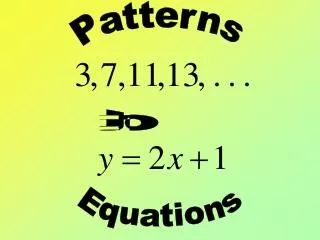
Patterns to Equations
Find the next three terms in the pattern: 1, 4, 7, . . .
Find the tenth term in the pattern: 1, 4, 7, 10, 13, 16, . . . 1st 2nd 3rd 4th 5th 6th 10th ?
The tenth term is 28 28 28 28 28 28
Now find the one-hundredth term: 1, 4, 7, 10, 13, 16, . . . 1st 2nd 3rd 4th 5th 6th 100th ?
You don’t really want to write out 100 terms, do you? 1, 4, 7, 10, 13, 16, . . . 1st 2nd 3rd 4th 5th 6th 100th ?
If so, go ahead and find the 1,000th term. 1, 4, 7, 10, 13, 16, . . . 1st 2nd 3rd 4th 5th 6th 1000th ?
If not, we need to find a better way. 1, 4, 7, 10, 13, 16, . . . 1st 2nd 3rd 4th 5th 6th 1000th ?
One way would be to write an equation which maps the number’s rank . . . 1, 4, 7, 10, 13, 16, . . . 1st 2nd 3rd 4th 5th 6th 1000th ?
. . . onto the number itself. 1, 4, 7, 10, 13, 16, . . . 1st 2nd 3rd 4th 5th 6th 1000th ?
Now 4 will map onto 10, 6 will map onto 16, and so forth. 1, 4, 7, 10, 13, 16, . . . 1st 2nd 3rd 4th 5th 6th 1000th ?
And 6 will be an x-value to correspond with a y-value of 16. 1, 4, 7, 10, 13, 16, . . . 1st 2nd 3rd 4th 5th 6th 1000th ?
How can we write the equation? 1, 4, 7, 10, 13, 16, . . . 1st 2nd 3rd 4th 5th 6th 1000th ?
.drawkcab krow s’teL Let’s work backward. .drawkcab krow s’teL
What happens to y each time x increases by 1? +1 +1 +4 +4
Each time x increases by 1, y increases by 4. +1 +1 +4 +4
Let’s try this equation: Predict what y will do as x increases by 1.
+1 +1 -3 -3
There is a pattern working here. The amount y changes each time x increases by 1 is part of the equation.
1, 4, 7, 10, 13, 16, . . . 1st 2nd 3rd 4th 5th 6th 100th ? So if we go back to the pattern we started with: +1 +1 +3 +3
We see that y increases by 3 each time x increases by 1, and we can start writing the equation.
When we use 1 for x, we know that y is also 1,
What is the 100th term in the pattern? 1, 4, 7, 10, 13, 16, . . . 1st 2nd 3rd 4th 5th 6th 100th ?
1. Find the change in y each time x changes by 1. +1 +1 -4 -4
2. Begin writing the equation, , using the change in y as m.
Write the equation: 1. 2. 3.
Answers: 1. 2. 3. * Press Enter
Did you notice that x is increasing by 2, not one? If y increases 10 every time x increases 2, what is the increase in y as x increases 1? 3.