
Portable Fire Extinguishers
E N D
Presentation Transcript
Portable Fire Extinguishers Chapter 11
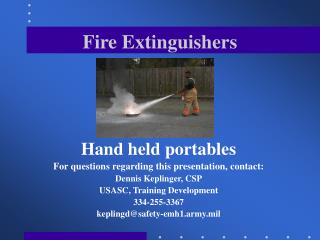
Introduction • Portable fire extinguishers are intended for use in incipient stage where water is ineffective • Useful if there is quick access, the correct type is available, and person is trained • Has fixed amount of suppression agent • Are clearly labeled and require little training • Rapid access to the extinguisher is critical
Requirements for Fire Extinguishers • Code requirements exist in all of the model codes for fire extinguishers • Requirements center on use and occupancy conditions and processes • IFC requires extinguishers installed in almost every new and existing occupancy classification • NFPA 10 lists the requirements for fire extinguishers
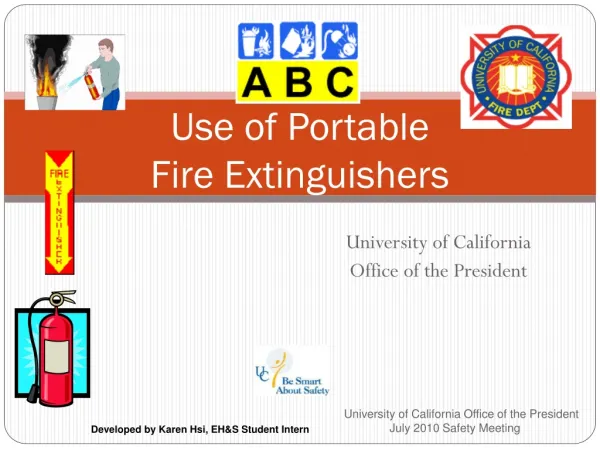
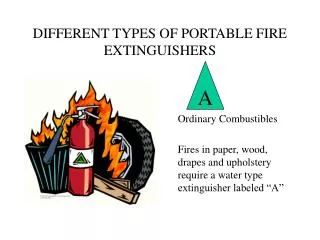
Fire Extinguisher Classification • Through the classification system, extinguishing agents matched to fire hazards • Classification designated with letters • Class A fires: ordinary combustibles • Class B fires. flammable and combustible liquids and gases • Class C fires: energized electrical equipment • Class D fires: combustible metals • Class K fires: cooking media
Fire Extinguisher Ratings • Class A and B have a number rating to indicate performance capability of the extinguisher • Expresses how much fire the extinguisher can handle • Class A extinguishers are tested using a wood crib on fire, allowing it to burn for a time • Class B extinguishers are tested with a flammable liquid fire in a pan • Flammable liquid is usually heptane • Class C extinguishers do not receive a rating
Types of Fire Extinguishers • Pumped, stored pressure, and cartridge pressure categories • Many suppression agents: • Water, foam, carbon dioxide, dry chemical, wet chemical, dry powder, halon, clean agents • Some agents will not work well with a particular category of extinguisher
Pump Extinguishers • Require manual operation of a pump mechanism • Creates pressure in the tank to expel extinguishing agent • Extinguishing agent is either water or antifreeze solution • Easy to operate and fill • Backpack type extinguisher has external pump • Mechanism similar to hand-held
Stored Pressure Extinguishers • Mix pressurized gas and extinguishing agent in the same tank • Gas is above the agent and keeps constant pressure on the agent • When operated, the pressure of the gas forces the extinguishing agent out of the tank • Air or nitrogen frequently used as expelling gas • Pressure gauge indicates if pressure is sufficient
Cartridge Pressure Extinguishers • Similar to stored pressure type, but pressurized gas is in a separate cartridge • Attached to the side of the extinguishing tank • Activating the extinguisher punctures the cartridge that expels the gas into the tank • Allows for easy maintenance of certain types of agents • Top removes without dumping the agent or losing the gas pressure • Good for agents that settle and need stirring
Common Fire Extinguisher Agents • Same agents used in sprinkler and suppression systems are common in fire extinguishers • Present in smaller amounts
Water • One of the best agents because it absorbs more heat per pound than any other material • Most effective on Class A fires • Not effective on some fuels; dangerous to use on others • When used in an extinguisher, extinguisher must not be exposed to cold
Foam • Good agent for Class A but better for Class B fires • Foam forms a vapor barrier between the fuel and the atmosphere • Agent must discharge through special aspirating nozzle so that air can mix with the agent • Two types of foam: • Aqueous film-forming foam • Film-forming fluoroprotein
Carbon Dioxide • Carbon dioxide gas effective in Class B and C fires; limited use on Class A fires • In extinguisher tank, carbon dioxide is a high-pressure liquid state • Expands to a gas when released • Depletes the oxygen supply • Must be discharged at close range to the fire because air movement carries the gas away • Operator must have oxygen supply available to avoid asphyxiation
Dry Chemicals • Small solid particles propelled by pressurized gas • When discharged, chemical smothers the burning material • Not considered dangerous or toxic; do not react with flammable liquids or gases; not conductive • Once discharged, create a cloud that limits visibility; may cause respiratory problems • May leave a corrosive residue
Wet Chemicals • Wet chemical agents most effective with Class K fires • Water-based solutions that mix with potassium carbonate, potassium acetate, potassium citrate • React with fat in the cooking medium or food to develop a soapy foam blanket on the surface • Smothers, cools, and extinguishes the fire • Liquid in the agent cools the cooking media adequately to maintain the foam blanket
Dry Powders • Class D fires present a challenge • Water is not a good choice because it can react with metals to liberate oxygen and fuel the fire • Dry powders are one of the most effective agents • No one powder effective on all metals • Some agents do not work in an extinguisher • Applied by shovel, scoop or by hand
Halon and Other Clean Agents • Halon still in use but less available • Gradual fade-out for environmental concerns • Leaves no residue; not conductive; more effective than the same amount of CO2 • Halons are somewhat toxic and exposure can cause physical problems • Vertigo, loss of agility, loss of coordination • Two types still in use: 1211, 1301 • Inert gases generally safe for humans
Summary • Portable fire extinguishers • Are intended to suppress small incipient fires • Hold a fixed amount of suppression agent, so access should be quick • Must have knowledgeable operator • Extinguishing agent must be suitable for the type of fire • Three categories of extinguishers: pumped, stored-pressure, cartridge pressure
Introduction • Smoke and toxic gases can migrate outside of the fire area • Smoke travels along stairways, ducts, corridors, elevator hoistways, etc. • Spread of smoke and toxic gases can cause much damage, injuries, and death • Passive design approach uses walls, etc., to create barriers • Active design approach uses mechanical systems to exhaust the air
Figure 12-1 Manually operated smoke and heat vent in stairway
Code Required Smoke Control and Smoke Management • Code-mandated installation of smoke control limited to certain structures • Many structures facilitate quick evacuation • Significantly compartmentalized to inhibit smoke travel • Installation of these systems in every structure is unnecessary • Requirements exist for occupancies with significant evacuation challenge
Smoke Containment, Removal, and Opposed Airflow • Basic goal of smoke control is to mitigate the spread of smoke • Smoke control techniques can be standalone or integrated into a building-wide approach • Systems use 100% outdoor air for positive pressurization • 100% exhaust to the outdoors for smoke relief • General approaches: containment, removal, opposed airflow
Containment by Pressure Differentials • Stairway pressurization: prevents or reduces smoke intrusion into egress stairways • Floating zone/floor-by-floor pressurization: uses the HVAC system • Elevator hoistway pressurization: similar to stairway pressurization • Refuge area pressurization: prevents smoke intrusion into refuge areas
Figure 12-2 This mechanical fan and duct line supply air to pressurize a stairway
Figure 12-4 Mechanical fan unit for “sandwich effect” pressurization
Figure 12-5 Exhaust vent in corridor for “sandwich effect” pressurization
Smoke Removal • Best suited for large volume spaces, such as atriums, indoor stadiums, and airport terminals • Provides vertical cross-flow ventilation from floor to roof • Large volume spaces have no barriers • Smoke and toxic gases will rise and spread throughout the area • Unpolluted air fed at a slower rate than the exhaust system rate • Fed from a level lower than the fire