Download
1 / 20
210 likes | 356 Vues
This guide explores the conjugation of Spanish -ar verbs in the present tense. It covers the basics of verbs, the infinitive form, and the concept of conjugation, which involves modifying the infinitive to indicate who is performing the action. Examples include common verbs like "estudiar," "hablar," and "tocar." The endings for -ar verbs are presented as well as instructions on negating sentences and forming questions in Spanish. This resource is ideal for students aiming to master the foundational aspects of Spanish verb conjugation.

E N D
Present Tense of -ar Verbs Verbosqueterminan en -ar
VERBS • A verb usually names the action in a sentence. • We call the verb that ends in -r the INFINITIVE
VERBS • The INFINITIVE is the form you would find in a Spanish dictionary. • In English it means • “to + (verb)”
Enseñar Estudiar Hablar Bailar Cantar Dibujar Escuchar These are some INFINITIVES you already know: • Esquiar • Jugar • Montar • Nadar • Pasar tiempo • Patinar • And several more!
IN SPANISH: • The last letter or letters of the verb tell you who does the action.
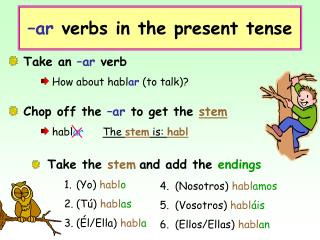
IN SPANISH: • To change an INFINITIVE to a form that tells who is doing the action, remove the -ar and add the appropriate ending.
IN SPANISH: • This action is called CONJUGATION
I study You study He She studies it We study They study TO STUDY (English)
Yo estudio Tú estudias Ud. Él estudia Ella Nosotros estudiamos Nosotras Vosotros estudáis Vosotras Uds. Ellos estudian Ellas ESTUDIAR (Spanish)
STEM / ENDING • For every INFINITIVE in Spanish there is a STEM and an ENDING.
STEM / ENDING • For example, for “estudiar,”…”estudi” is the stem. • “ar” is the ending.
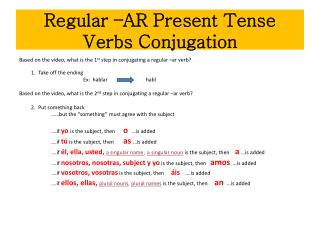
STEM / ENDING • So, the endings for -ar verbs are: • o, as, a, amos, áis, an
THE VOSOTROS • Verb forms ending in áis, such as estudiáis, are used mainly in the country of Spain only.
Let’s CONJUGATE Some more -ar verbs!
Yo toco Tú tocas Ud. Él toca Ella Nosotros tocamos nosotras Vosotros tocáis vosotras Uds. Ellos tocan Ellas TOCAR
Yo enseño Tú enseñas Ud. Él enseña Ella Nosotros enseñamos Vosotros enseñáis Uds. Ellos enseñan Ellas Enseñar
NEGATING A SENTENCE • When you want to say that you do not do something, use no before the verb form
NEGATING A SENTENCE • Yo no cocino en la clase de educación física.
ASKING A QUESTION • When we ask a question in Spanish, we usually put the subjectafterthe verb or sometimes at the end of the sentence.
ASKING A QUESTION • Cocina Juan en la clase de ciencias? • Estudia mucho Paulina? • Verb Subject