Visual Informatics and Genomics using the Pipeline
10 likes | 144 Vues
This work presents an innovative approach for Visual Informatics and Genomics using a distributed graphical interface. The LONI Pipeline is employed to address challenges of massive data (over 2GB per subject), heterogeneous software tools, and distributed hardware systems. Key features include interoperability, community-based protocol validation, and a collection of computational tools like miBLAST, SAMtools, and Bowtie. The protocol ensures detailed data processing, study design validation, and the execution of reliable analyses, promoting open sharing and cross-disciplinary collaboration in genomic research.


Visual Informatics and Genomics using the Pipeline
E N D
Presentation Transcript
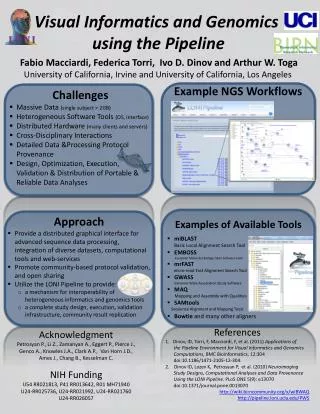
Visual Informatics and Genomics using the Pipeline Fabio Macciardi, Federica Torri, Ivo D. Dinov and Arthur W. Toga University of California, Irvine and University of California, Los Angeles Example NGS Workflows • Challenges • Massive Data (single subject > 2GB) • Heterogeneous Software Tools (OS, interface) • Distributed Hardware (many clients and servers) • Cross-Disciplinary Interactions • Detailed Data &Processing Protocol Provenance • Design, Optimization, Execution, Validation & Distribution of Portable & Reliable Data Analyses • Approach • Provide a distributed graphical interface for advanced sequence data processing, integration of diverse datasets, computational tools and web-services • Promote community-based protocol validation, and open sharing • Utilize the LONI Pipeline to provide: • a mechanism for interoperability of heterogeneous informatics and genomics tools • a complete study design, execution, validation infrastructure, community result replication • Examples of Available Tools • miBLAST • Basic Local Alignment Search Tool • EMBOSS • European Molecular Biology Open Software Suite • mrFAST • micro-read Fast Alignment Search Tool • GWASS • Genome-Wide Association Study Software • MAQ • Mapping and Assembly with Qualities • SAMtools • Sequence Alignment and Mapping Tools • Bowtieand many other aligners References Dinov, ID, Torri, F, Macciardi, F, et al. (2011) Applications of the Pipeline Environment for Visual Informatics and Genomics Computations, BMC Bioinformatics, 12:304 doi:10.1186/1471-2105-12-304. 2. Dinov ID, Lozev K, Petrosyan P, et al. (2010) Neuroimaging Study Designs, Computational Analyses and Data Provenance Using the LONI Pipeline. PLoS ONE 5(9): e13070 doi:10.1371/journal.pone.0013070 http://wiki.birncommunity.org/x/wIBWAQ http://pipeline.loni.ucla.edu/PWS Acknowledgment Petrosyan P., Li Z., Zamanyan A., Eggert P., Pierce J., Genco A., Knowles J.A., Clark A.P., Van Horn J.D., Ames J., Chang B., Kesselman C. NIH Funding U54 RR021813, P41 RR013642, R01 MH71940 U24-RR025736, U24-RR021992, U24-RR021760 U24-RR026057