
SlideServe
Menu
Préférences
© SlideServe · v2026

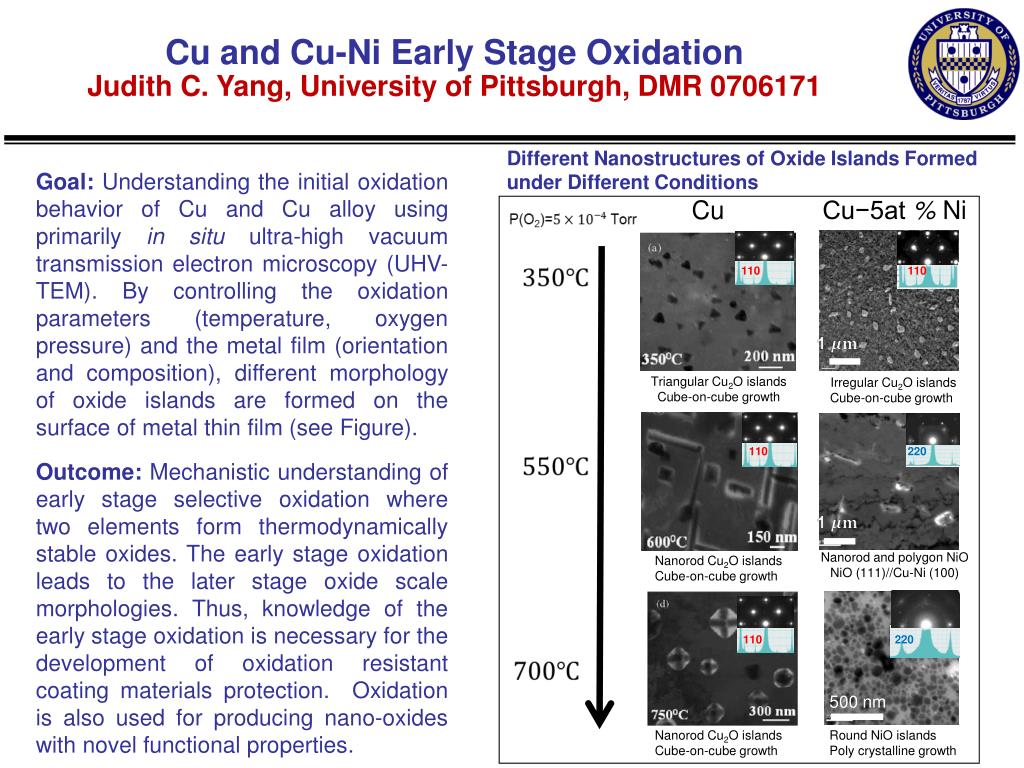
Different Nanostructures of Oxide Islands Formed under Different Conditions

dasha avatar
2 diapositives · 167 Views · Oct 13, 2014

Cu and Cu-Ni Early Stage Oxidation Judith C. Yang, University of Pittsburgh, DMR 0 706171. Different Nanostructures of Oxide Islands Formed under Different Conditions.
Different Nanostructures of Oxide Islands Formed under Different Conditions - slide 1
01 / 2Different Nanostructures of Oxide Islands Formed under Different Conditions
1 / 17

Télécharger la présentation

Different Nanostructures of Oxide Islands Formed under Different Conditions
Une image / un lien ci-dessous est fourni (tel quel) pour télécharger la présentation

Politique de téléchargement : le contenu du site vous est fourni TEL QUEL pour votre information et votre usage personnel ; il ne peut être vendu, concédé sous licence ni partagé sur d’autres sites sans l’accord de son auteur.Le contenu vous est fourni TEL QUEL, pour votre information et votre usage personnel uniquement. Téléchargez la présentation en cliquant sur ce lien. Lors du téléchargement, si vous ne parvenez pas à télécharger une présentation, l’éditeur a peut-être supprimé le fichier de son serveur.Pendant le téléchargement, si vous ne parvenez pas à obtenir une présentation, le fichier a peut-être été supprimé par l’éditeur.

F I N

Plus de contenu associé

Transcription de la présentation
  1. Cu and Cu-Ni Early Stage Oxidation Judith C. Yang, University of Pittsburgh, DMR 0706171 Different Nanostructures of Oxide Islands Formed under Different Conditions Goal: Understanding the initial oxidation behavior of Cu and Cu alloy using primarily in situ ultra-high vacuum transmission electron microscopy (UHV-TEM). By controlling the oxidation parameters (temperature, oxygen pressure) and the metal film (orientation and composition), different morphology of oxide islands are formed on the surface of metal thin film (see Figure). Outcome: Mechanistic understanding of early stage selective oxidation where two elements form thermodynamically stable oxides. The early stage oxidation leads to the later stage oxide scale morphologies. Thus, knowledge of the early stage oxidation is necessary for the development of oxidation resistant coating materials protection. Oxidation is also used for producing nano-oxides with novel functional properties. Cu Cu−5at % Ni 110 110 Triangular Cu2O islands Cube-on-cube growth Irregular Cu2O islands Cube-on-cube growth 110 220 500 nm Nanorod and polygon NiO NiO (111)//Cu-Ni (100) Nanorod Cu2O islands Cube-on-cube growth 110 220 500 nm Nanorod Cu2O islands Cube-on-cube growth Round NiO islands Poly crystalline growth

  2. Cu and Cu-Ni Early Stage Oxidation Judith C. Yang, University of Pittsburgh, DMR 0706171 Pre-commercialization of Ex situ Gas Reactor Compatible TEM Heating Holder in Collaboration with RJLG and Protochips Research Experience: Graduate Student: This grant provides the support for one graduate student: Yihong Kang International Visiting Graduate Research Experience: This grant provides the support one male international visiting graduate student from in Materials Science and Engineering, State University of New York, Binghamton, NY 13902: Langli Luo Cu(001) Cu2O Impacts: Industrial Collaboration: Collaboration woth R J Lee group inc and the Protochip Inc in the development of an ex situ gas reaction chamber compatible with TEM (see Figure). Outreach: Participation in the 3rd Pennsylvania Junior Academy of Science (PJAS) workshop in Nanotechnology (10/2/10). (Top) Prototype of ex situ gas reactor compatible with TEM heating holder; (bottom) oxidation of Cu(001) to form oxide islands was used to test and evaluate the prototype.