The Water Cycle
This overview of the water cycle explores various processes including evaporation, condensation, and precipitation. It analyzes water storage capacities in oceans, lakes, rivers, and glaciers, outlining the annual fluxes between these reservoirs. Key statistics highlight how ocean evaporation reaches 434,000 km³ per year, while precipitation to oceans is 398,000 km³ per year. Additionally, the residence times of water in different forms, from years for rivers to millennia for groundwater, are discussed, showcasing the intricate balance of Earth's water systems and their significance to climate dynamics.

The Water Cycle
E N D
Presentation Transcript
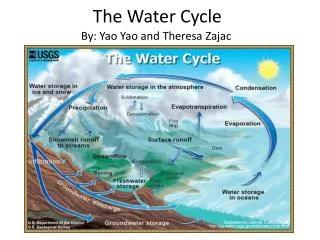
The Water Cycle By: Yao Yao and Theresa Zajac
Atmosphere Ocean Evaporation 434000 km3/year Storage: 13000 km3 Precipitation to Ocean 398000 km3/year Lands Evaporation 71000 km3/year Precipitation to Lands 107000 km3/year Residence Time=Amount/Flux
Surface water Precipitation 398000 km3/y Ocean: 1370 million km3 Evaporation 434000 km3/y 3000 years Runoff 36000 km3/y Precipitation Runoff 42600 km3/y Lakes: 3608600 km3 Evaporation Runoff 86 years Precipitation Runoff 6800 km3/y Rivers: 1700 km3 Evaporation Runoff 3 months
Glaciers, Ice Caps, and Permanent Snow Ice Caps, Glacier, & Perm. Snow: 24,064,000 km3 2188 years Melting 11000 km3/year Source: Gleick, P. H., 1996: Water resources. In Encyclopedia of Climate and Weather, ed. by S. H. Schneider, Oxford University Press, New York, vol. 2, pp.817-823.
Ground Water • Shallow – 100-200 years • Deep – Up to 10,000 years Source: Gleick, P. H., 1996: Water resources. In Encyclopedia of Climate and Weather, ed. by S. H. Schneider, Oxford University Press, New York, vol. 2, pp.817-823.