Download

1 / 7
70 likes | 198 Vues
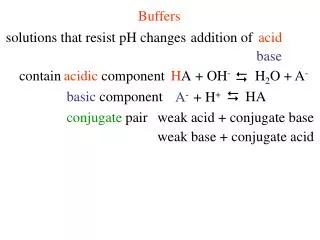
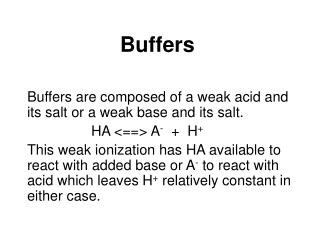
This chapter explores the behavior of salts when they interact with acids and bases, an essential concept in chemistry. It explains the formation of different types of salts such as neutral, basic, and acidic salts depending on the strength of the acids and bases involved. The chapter delves into the significance of buffers, particularly in biological systems, highlighting how blood plasma utilizes carbonic acid and bicarbonate to maintain pH levels between 7.35 and 7.45, ensuring proper physiological function.

E N D
Salts in SolutionBuffers Chapter 19.5
Learning Objectives • How salts behave when interacting with acids and bases • What are buffers and their properties
3 Scenarios for Salt Formation Strong A + Strong B = neutral salt Weak A + Strong B = basic salt Strong A + Weak B = acidic salt
Buffers in our Blood Blood plasma contains a buffer of carbonic acid (H2CO3) and bicarbonate (HCO3-) to maintain our blood pH between 7.35 and 7.45