Download
1 / 12
120 likes | 214 Vues
Nuclear power generates electricity by utilizing uranium isotopes through nuclear fission, offering cost-competitive energy production for over 1000 years. Despite some drawbacks, it is a low-CO2 emission energy solution with vast potential. Learn more about the pros and cons, energy generation process, and current global usage trends.

E N D
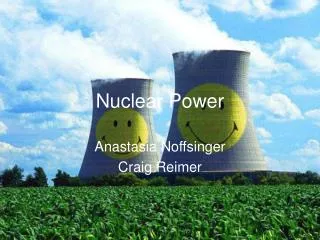
Nuclear Power Anastasia Noffsinger Craig Reimer
Use • Generate Electricity • Propelling naval vessels
Renewable • Uses Uranium Isotopes • Uranium is abundant in the earths crust • Nuclear fission uses Uranium 238, Which makes up 99% of all Uranium. • The continued rate of consumption of Uranium will allow use for over 1000 years.
Cost • Nuclear power is cost competitive with other forms of electricity generation. • Nuclear energy cost about .4 Euro cents/kWh • Coal over 4 cents, gas 1.3-2.3 cents. Only wind energy is cheaper at .1-.2 cents/kWh • 130 USD/Kg • While the cost of Fuel is relatively low, the construction on the reactors is excessive. • $2,980,000 per unit for power reactor licensees • $57,300 for non-power (research and test) reactor licensees • $2,607,000 for high-enriched uranium fuel licensees • $1,280,000 for low-enriched fuel fabrication licensees which manufacture fuel for nuclear power plants • $14,100 for radiographers • $23,500 for broad scope medical licensees
Pros • A lot of energy for a little fuel • Nuclear power plant Co2 emissions are minimal • New technology makes meltdowns highly unlikely • Doesn’t depend on fossil fuels • Realeases less radioactivity into the atmosphere than a coal fired power plant
Cons • Production of highly radioactive waste. Aka used Uranium • Which is difficult to store • Also a great level of low radioactive waste with radiated parts and equipment. • Possibility of a meltdown. • A large amount of water use. During all processes of the nuclear process. Including storing and cooling.
Energy • Created by bombarding Uranium with neutrons. When the Uranium atom splits more neutrons are released, causing a chain reaction. • The heat released by the reaction is used in a boiler to power a turbine and produce electricity. • The by product of the nuclear reaction is radioactive wastes.
Availability • Currently 15% of the worlds electricity is produced by nuclear power. • France is currently the leader in nuclear power use. • In the 80s nuclear power was extremely popular, the 90s saw a decline in the use of nuclear power.
Bibliography • http://www.howstuffworks.com/nuclear-power.htm • http://web.mit.edu/nuclearpower/ • http://www.solcomhouse.com/nuclear.htm • http://www.nuclearnow.org/ • http://benkay.net/blog/wp-content/uploads/2008/08/nuclear-power_5810.jpg • Plan B 3.0 • MILLER Lite