
Exploring Telescopes: Parts, Magnification, & Types
E N D
Presentation Transcript
Telescopes Chapter 5
Objectives • Telescopes……………Chapter 5 Objectives: • 1. To list the parts of a telescope. • 2. To describe how mirrors aid in telescope magnification. • 3. To describe three different types of telescopes. • 4. To construct a simple telescope.
What do you think of when someone asks you about a telescope? • Some of these terms should come to mind:
Types of telescopes • Interferometers (not a type of telescope, but decrease light interference) • Radio telescopes
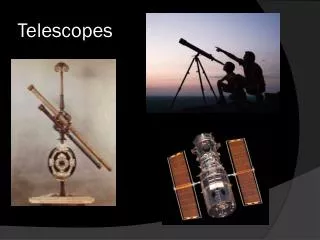
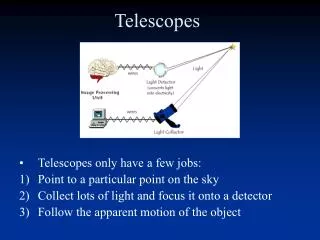
Telescopes • The most basic telescopes work by gathering light, then focusing and/or “bending light” onto a particular spot. • This causes an increase in the magnification of an image.
What are the two most important properties of a telescope? • ______________________________: Also called Collecting Power. Telescopes with a larger collecting area can gather a greater amount of light in a shorter time. • _______________________________: Also called Resolving Power. Telescopes that are larger are capable of taking images with greater detail.
Determining a good telescope • _______________________ – how much more light that a telescope can gather than the human eye. • The larger the lens, the more collecting power • This allows for a brighter image (easier for you to see) • This is the primary reason for making telescopes larger. • Telescopes are first described by the diameter of its light collecting device (mirror or lens) • Once light is collected then it must be focused.
Determining a good telescope • How light is focused • ___________________ – Light is focused to form a particular image using a lens. • Relies on the process of ___________________ which is the bending of light when it goes through different media. Occurs because the speed of light changes when it enters the lens. • Refraction also spreads the light out. Results in the colors of the rainbow. • ___________________– The spreading of light or other electromagnetic radiation into a spectrum. • The light rays are bent when they go through one media (air) and then another (glass)
Refracting Telescopes • Use _______________ to focus light • Are limited by the size and quality of the lens. • Most modern telescopes are reflecting telescopes as opposed to refracting telescopes.
Focusing Light Cameras detect light with charge-coupled devices (CCDs). • A camera focuses light like an eye and captures the image with a detector. • Because we can control the exposure time (amount of time the light collects on the detector), a camera can record details that are too faint to see with our eyes alone. • The CCD detectors in digital cameras are similar to those used in modern telescopes.
Determining a good telescope • Besides collecting light, telescopes also allow us to discern objects as single large object or several small individuals • ______________________________ – The ability of a telescope or instrument to discern fine details. Larger diameter telescopes have greater resolving power than smaller ones. • Resolving power is limited because light waves can be diffracted. • Diffraction – • Diffraction limits the resolving power of a telescope.
Reflecting telescopes • Use __________________ to collect and focus light. • Reflectors are slightly curved mirrors • Light does not go through them and as a result is not dispersed. • Most telescopes today are reflecting • Multiple mirrors bounce the light around, each time bending it slightly and thus magnifying the image.
Atmospheric Refraction • Occurs for objects viewed in the sky. • The gases of the atmosphere bend light and change the appearance of an object • ________________________ refraction makes the sun look higher in the sky than it really is. • Atmospheric refraction is stronger closer to the horizon. Causes the sun to look flat as it sets.
Interferometers • A device consisting of ____________ ______________________ connected together to work as a single instrument. • Allow for a high resolving power, the ability to see small scale features. • Can be used to increase the power of radio, infrared, and visible wavelengths.
Observatories • As far as telescopes discussed by the groups, for the test, make sure to look over the telescopes and observatories discussed in the book. • Remember that SEVERAL telescopes are located in Hawaii (Mauna Kea) • Why are so many telescopes in HI?
Light Pollution • ___________________________ is city light scattering off the atmosphere and into a telescope. • Scattering of human-made light in the atmosphere is a growing problem for astronomy when using land-based telescopes.
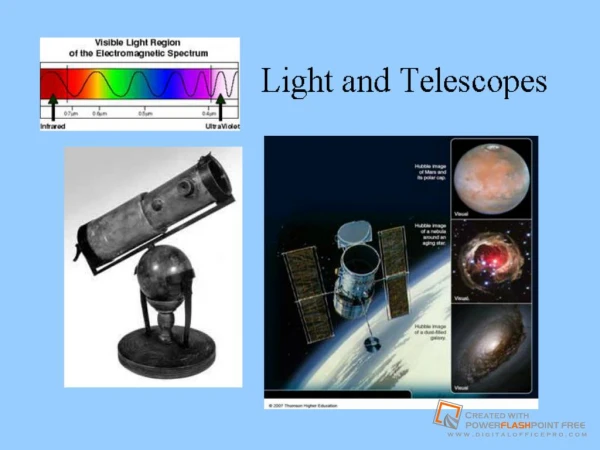
Benefits of Space Telescopes • Only radio and visible light pass easily through Earth’s atmosphere. We need telescopes in space to observe other forms.
Non optical telescopes • Most X rays and UV light is absorbed by the atmosphere. • Radio waves can penetrate the atmosphere. • Gamma ray telescopes measure gamma rays that are released during nuclear explosions. • These explosions occur during stellar evolution.