Understanding Atomic Structure and the Periodic Table
Dive into the foundational concepts of atomic structure and the organization of the periodic table. Explore key elements such as protons, electrons, and neutrons, and how they define the nature of an atom. Learn about isotopes, periodic law, noble gases, and the significance of rows and columns in the periodic table. This guide provides essential insights into the properties of elements, their classification, and the unique characteristics of metalloid elements, enhancing your comprehension of chemistry fundamentals.

Understanding Atomic Structure and the Periodic Table
E N D
Presentation Transcript
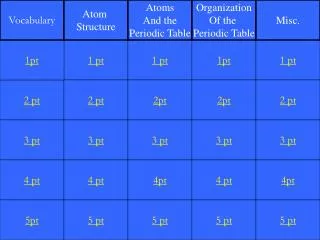
Vocabulary Atom Structure Atoms And the Periodic Table Organization Of the Periodic Table Misc. 1pt 1 pt 1 pt 1pt 1 pt 2 pt 2 pt 2pt 2pt 2 pt 3 pt 3 pt 3 pt 3 pt 3 pt 4 pt 4 pt 4pt 4 pt 4pt 5pt 5 pt 5 pt 5 pt 5 pt
Final Jeopardy
electron 1 pt
The smallest part that an element can be broken down to and retain its physical and chemical properties.
atom 2 pts
The name given to the group of elements that are the most stable.
Noble gas 3 pts
Isotope. 4 pts
Properties of elements change periodically with the elements’ atomic number according to this.
Periodic law 5 pts
proton 1 pt
electron 2 pts
This part of the atom is in the center and includes protons and neutrons.
nucleus 3 pts
Is it possible for carbon (C) to have 7 protons? Explain your answer.
No. If it has 7 protons it is a different element. It is nitrogen (N). 5 pts
Chlorine 1 pt
12 2 pts
The atomic number of an atom, as it appears on the periodic table of elements, is the same as the number of ______.
Protons and electrons 3 pts
An atom of cesium (Cs) has 55 protons, 55 electrons and 78 neutrons. What is its atomic mass?
133 4 pts
24 5 pts
The horizontal rows on the periodic table are called ________.
Periods. 1 pt
The vertical columns on the periodic table are called ________.
Groups or families 2 pts
Most of the elements on the periodic table are to the left of the zigzag line and are classified as this.
metals 3 pts
Lithium (Li), sulfer (S), nickel (Ni) or germanium (Ge). Which of these is a metalloid?
Germanium (Ge) 4 pts
Protons and neutrons 1 pt
Metals and non-metals 2 pts
Heat and electricity 3 pts
These 2 groups on the periodic table of elements are the most reactive.