Download

1 / 13
140 likes | 272 Vues
This guide explores the concept of price elasticity of demand, focusing on how demand for a product changes in response to price fluctuations. When prices rise, demand typically decreases, but the extent of this change varies. We explain the elasticity formula and the relationship between total revenue and elasticity. Additionally, we discuss the determinants of elasticity, such as brand loyalty and the availability of substitutes, and how they influence consumer behavior in the marketplace.

E N D
Elasticity – the concept • The degree to which demand for a product is affected by a change in price • When price rises, what happens to demand? • Demand falls • BUT! • How MUCH does demand fall?
Elasticity – the concept • If price rises by 10% - what happens to demand? • We know demand will fall • By more than 10%? • By less than 10%? • Elasticity measures the extent to which demand will change
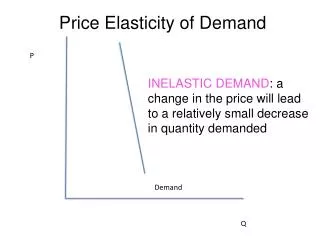
Elasticity Price Elasticity of Demand The responsiveness of demand to changes in price Where % change in demand is greater than % change in price elastic Where % change in demand is less than % change in price - inelastic
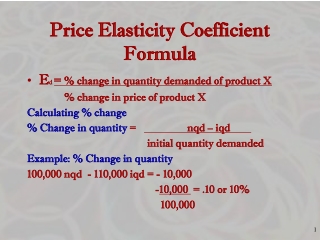
Elasticity The Formula: % Change in Quantity Demanded Ped = __________________________ % Change in Price If answer is between 0 and -1: the relationship is inelastic If the answer is between -1 and -infinity: the relationship is elastic
Law of Diminishing Marginal Utility After eating X amount of food, your satisfaction of the additional food becomes lesser…. Consumers will only buy so much of a given product, even though the price is low
Elasticity Price ($) The demand curve can be a range of shapes each of which is associated with a different relationship between price and the quantity demanded. Quantity Demanded
Elasticity Price Total revenue is price x quantity sold. In this example, TR = $5 x 100,000 = $500,000. This value is represented by the grey shaded rectangle. The importance of elasticity is the information it provides on the effect on total revenue of changes in price. $5 Total Revenue D 100 Quantity Demanded (000s)
Elasticity Price ($) Producer decides to lower price to attract sales 10 % Δ Price = -50% % Δ Quantity Demanded = +20% Ped = -0.4 (Inelastic) Total Revenue would fall 5 Not a good move! D 5 6 Quantity Demanded
Elasticity Price If the firm decides to decrease price to (say) $3, the degree of price elasticity of the demand curve would determine the extent of the increase in demand and the change therefore in total revenue. $5 $3 TotalRevenue D 100 140 Quantity Demanded (000s)
Elasticity Price ($) Producer decides to reduce price to increase sales % Δ in Price = - 30% % Δ in Demand = + 300% Ped = - 10 (Elastic) Total Revenue rises 10 Good Move! 7 D 20 5 Quantity Demanded
If demand is price elastic: Increasing price would reduce TR (%Δ Qd > % Δ P) Reducing price would increase TR (%Δ Qd > % Δ P) If demand is price inelastic: Increasing price would increase TR (%Δ Qd < % Δ P) Reducing price would reduce TR (%Δ Qd < % Δ P) Elasticity-logically...
Determinants of Elasticity • Brand Loyalty/Number and closeness of substitutes – the greater the number of substitutes, the more elastic • The proportion of income taken up by the product – the smaller the proportion the more inelastic, price increase big or small? • Luxury or Necessity- medicine • Urgency of Purchase – gas