Download
1 / 41
410 likes | 537 Vues
This lesson plan for September 26, 2012, focuses on classifying substances as elements, compounds, homogeneous mixtures, or heterogeneous mixtures. Students will engage in activities and discussions that promote understanding of pure substances and mixtures. The agenda includes a bell ringer, stations on classifying matter, a class competition, and an exit ticket. Key concepts cover definitions of chemistry, reading the periodic table, and understanding atomic structure. The goal is for students to accurately categorize substances through interactive learning methods.

E N D
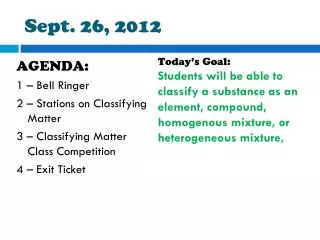
Sept. 26, 2012 AGENDA: 1 – Bell Ringer 2 – Stations on Classifying Matter 3 – Classifying Matter Class Competition 4 – Exit Ticket Today’s Goal: Students will be able to classify a substance as an element, compound, homogenous mixture, or heterogeneous mixture,
CHAMPS for Bell Ringer C – Conversation – No talking. H – Help – RAISE HAND for questions, do not call me over verbally A – Activity – Answer Questions on your bell ringer sheet (5 min), you’ll submit it Friday. M – Materials and Movement – Pen/Pencil, Bell Ringer sheet, notes. Stay in seats. P – Participation – Work on bell ringer. S – Success – Finish bell ringer in 5 min.
Thursday, Sept. 27 Objective: Students will review for their quiz tomorrow. Bell Ringer: 1. How do you classify a substance as an element, compound, pure substance, or mixture?
1.1a – Students will define Chemistry & understand the difference between a scientific law and a scientific theory. 1.1b - Students will learn to read the periodic table (the symbol, name, atomic number, atomic weight) 1.1c – Students will describe the subatomic components of an atom (protons, neutrons, and electrons) and their charges. 1.1d – Students will understand the relationship between atomic number and the number of protons. Students will understand the relationship between the atomic mass and the number of protons and neutrons 1.1e – Students will understand that most of the mass of an atom is found in the nucleus. 1.1f – Students will understand that isotopes have the same number of protons but different numbers of neutrons. 1.1g – Students will understand how to calculate the number of neutrons from the atomic number and the mass number 1.2a – Students will understand the difference between elements and compounds and pure substances / mixtures. 1.2b - Students will understand the difference between homogenous and heterogeneous mixtures.
Wednesday, Sept. 26 Objective: Students will be able to classify a substance as an element, compound, homogenous mixture, or heterogeneous mixture, Bell Ringer: 1. What is a pure substance? 2. What is a mixture?
Wednesday, Sept. 26 Objective: Students will be able to classify a substance as an element, compound, homogenous mixture, or heterogeneous mixture, Bell Ringer: 1. What is a pure substance? 2. What is a mixture?
Wednesday, Sept. 26 Objective: Students will be able to classify a substance as an element, compound, homogenous mixture, or heterogeneous mixture, Bell Ringer: 1. What is a pure substance? 2. What is a mixture?
Wednesday, Sept. 26 Objective: Students will be able to classify a substance as an element, compound, homogenous mixture, or heterogeneous mixture, Bell Ringer: 1. What is a pure substance? 2. What is a mixture?
Wednesday, Sept. 26 Objective: Students will be able to classify a substance as an element, compound, homogenous mixture, or heterogeneous mixture, Bell Ringer: 1. What is a pure substance? 2. What is a mixture?
Sept. 26, 2012 AGENDA: 1 – Bell Ringer 2 – Stations on Classifying Matter 3 – Classifying Matter Class Competition 4 – Exit Ticket Today’s Goal: Students will be able to classify a substance as an element, compound, homogenous mixture, or heterogeneous mixture,
Week 2 Weekly Agenda Mon 9/24 – REACH Assessment Tues 9/25 – Classifying Matter Day 1 Wed 9/26 – Classifying Matter Day 2 Thurs 9/27 – Physical & Chemical Properties, Review Fri 9/28 – QUIZ 1 & Plan
CHAMPS for Station Work C – Conversation – Quiet Whisper ONLY. H – Help – RAISE HAND for questions, do not call me over verbally A – Activity – Take Cornell Notes and Answer Questions. M – Materials and Movement – Pen/Pencil, Notebook or Paper. You will switch stations every 5 minutes. P – Participation – Complete your notes, do demonstrations S – Success – Gain conceptual understanding
Station Work: Take out a pen or pencil and paper. I will assign you to a station. We will switch every 5 minutes. Topic: Classifying Matter Date: 9/26/2012
CHAMPS for Competition C – Conversation – Quiet Whisper ONLY. H – Help – RAISE HAND for questions, do not call me over verbally A – Activity – Discuss answer with your group, have 1 person raise their hand when ready. M – Materials and Movement – Pen/Pencil, Notebook or Paper. Stay in seats. P – Participation – Discuss with group. S – Success – Take good notes on explanations of answers. Be able to explain WHY.
Competition: Classify the following as a pure substance or mixture Topic: Classifying Matter Date: 9/25/2012
Competition: Classify the following as an element, compound, homogenous mixture, or heterogeneous mixture Topic: Classifying Matter Date: 9/26/2012
Grain Alcohol (C2H5OH)
CHAMPS for Exit Ticket C – Conversation – NO Talking H – Help – RAISE HAND for questions, do not call me over verbally A – Activity – Answer Exit Ticket Questions on a loose leaf piece of binder paper. M – Materials and Movement – Pen/Pencil, Paper. Stay in seats. No notes. P – Participation – Work silently by yourself. S – Success – Write clear answers in complete sentences.
Exit Ticket 9/25 1. Classify aluminum as a pure substance or mixture. 2. Classify air as a pure substance or mixture. 3. Classify carbon dioxide as an element, compound, homogenous, or heterogeneous mixture. 4. Classify ice as an element, compound, homogenous, or heterogeneous mixture. 5. Classify a Big Mac as an element, compound, homogenous, or heterogeneous mixture.