Understanding Units and Dimensionality in Measurement Systems
This overview discusses the various measurement systems, focusing on the International System of Units (SI), including fundamental and derived units for length, mass, time, temperature, charge, and force. It contrasts SI with the US/British systems, detailing conversions and dimensionality principles. Exercises are provided to practice conversions between metric and US units. Furthermore, it emphasizes the importance of dimensional homogeneity in equations, illustrating how every term must have consistent dimensions. Ideal for students and professionals in science and engineering fields.

Understanding Units and Dimensionality in Measurement Systems
E N D
Presentation Transcript
Systems of Units • SI – SystemeInternationale • Metric system • MKS system • US/British • Non-metric • Used by US and UK
Fundamental Units • SI • Meter • Kilogram • Second • US/UK • Foot • Pound • Second
SI System • Primary / Fundamental units • Unit of length - Meter - m • Unit of mass – kilogram – kg • Unit of time – second – s • Unit of temperature – Kelvin – K • Unit of charge – Coulomb – C
SI Secondary/Derived Units • Unit of force – Newton – N • F = ma • 1 Newton = 1 kg x 1 m/s2 • Unit of Work/Energy • W = F x displacement • 1 Joule = 1 Newton x 1 meter = 1 N-m • Energy is also expressed in Joules
Secondary Units • Power • P = W/t • 1 Watt = 1 Joule/sec = 1 J/s = 1 N-m/s • Speed • v = dx/dt = distance/time • v = meters/sec = m/s • Acceleration • a = dv/dt = meters/sec/sec = m/s2
Secondary Units • Current • I = dQ/dt • 1 Ampere = 1 Coulomb/sec • 1 A = 1C/s
US System • Primary units • Foot - length - ft • Force – pound – lb • Time – second – s Some people refer to the unit of force in the US system as a pound force or lbf
Secondary Units - US • Mass – slug • F = ma • M = F/a • 1 slug = 1 pound/(1 ft/s2) • Work • W = Force x displacement • 1 ftlb = 1 lb x 1 ft • Energy is expressed in ftlb as well
Secondary Units US • Speed • v = dx/dt • v – ft/s • Acceleration • a = dv/dt • a = ft/s2 • Power - horsepower
SI - Prefixes • Giga x 109 • Mega x 106 • Kilo x 103 • Deci x 10-1 • Centi x 10-2 • Milli x 10-3 • Micro x 10-6 • Nano x 10-9 • Pico x 10-12
Class Exercise 1 • A car is traveling at a speed of 65 mph on I195E. • What is its speed in ft/s? • What is its speed in kmh? • What is its speed in m/s?
Class Exercise 2 • What is your own height in feet and inches? • Convert your height to meters. • What is your own weight in pounds? • Is weight a force or a mass? • Convert your weight to oz? • Convert your weight to Newtons. • What is your mass in the Si system? In the US system?
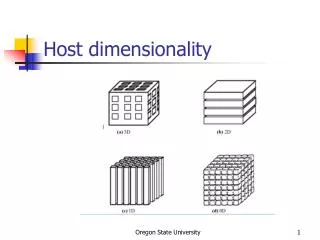
Dimensionality • There is a difference between units and dimensions/dimensionality. • Distance is expressed in units of length, e.g. m or ft. • The dimensionality of distance if L • The dimensionality of mass is M • The dimensionality of time is T
Dimensionality (cont’d) • Force has a dimensionality of ? • F = m x a • [F] means the dimensionality of force • [F] = [m] x [a] = M x L/T2 • W = F x distance • [W] = [F] x [distance] = (M x L/T2) x L • [W] = ML2 /T2
Special Cases • The argument of a trigonometric, logarithmic, or exponential function , e.g. sin (x), log (x), exp (x) must be dimensionless. • In the function sin ϴ, the argument ϴ must be dimensionless. • Degrees or radians are dimensionless • In the function exp (-Q/kT), the argument must be dimensionless.
Class Exercise 3 • Consider the function exp (-Q/kT), where Q is an energy and T is a temperature. k is the Boltzmann constant. • Determine the dimensionality of k. • What would be the units of k in the SI system?
Dimensional Homogeneity • Every term in an equation must have the same dimensionality. • Consider the equation ΔG = 4πR3 Δg/3 + 4πR2σ Where ΔG is an energy, R is the radius of a sphere, Δg is an energy per unit volume, and σ is a surface energy. • Is this equation dimensionally homogeneous?