Moving & Using Static Charge
This lesson explores the principles of static electricity, focusing on the various types of charge: static, contact, and induction. Students will investigate the differences between insulators and conductors, learning how materials allow or resist the flow of electrons. Through hands-on activities, including conductivity testing and the use of an electroscope, students will gain practical insights into electric discharge and grounding. By the end of the lesson, students will be able to compare charge types and material properties, enhancing their understanding of electrical conductivity.

Moving & Using Static Charge
E N D
Presentation Transcript
Moving & Using Static Charge Text 10.1-10.2: Page 400-411
Agenda • Review of Static Charge • Moving Charge • Different Materials • Contact Charge • Induction Charge • Grounding • Electric Discharge • Electroscope Review Activity
Learning Goals • By the end of this class, we should be able to • Compare and contrast insulators and conductors • Compare and contrast static, contact and induction charge • Complete an investigation to test types of current charge and conductivity of materials
Materials • Materials can be grouped by weather they allow charge to move through them • Insulators and Conductors are groupings determined by their conductivity • Conductivity is the ability of materials to allow Martials to allow electrons to move freely in them.
Insulators • Material that hold onto their electrons and do not allow them to move easily are called electrical insulators • An insulator is a solid, liquid or gas that resists or blocks the movement of electrons • EX: dry wood, glass and plastic
Conductors • Materials that allow electrons to change positions are called conductors • Conduction is the movement or transmission of electrons through a substance • Ex. Copper and aluminum
Somewhere in the Middle? • Some materials only allow some movement of electrons • These are called fair conductors • Sort of like an insulator, sort of like a conductor • NOTE: only PURE water is an insulator • Most water has minerals in it so it is considered a fair conductor
Let’s Test It – Conductivity Test • Assemble the electrical conductivity apparatus. • Test conductivity of different samples.
How Can You Test For Charge? • You can use an electroscope • This is an instrument used to detect electric charge • Metal-Leaf electroscope has a two very thin metal pieces called leaves suspended from a metal rod. • The metal rod is then attached to a top plate or metal knob
Contact Charge • This is an example of Contact Charge • This can also be called charge by contact • The charge is made through contact with another charged object
Induction Charge • This is very similar to contact charge • Is the movement of electrons between objects close by but not in direct contact • EX: you can statically – charge a balloon by rubbing it on your hair • Put the balloon near a wall and it will attract to it! • No contact is made
Grounding • Grounding is the process of connecting a charged object to the earth’s surface • This creates a path for the electrons to travel to the ground • “Escape route” for electrons which removes charge
Electric Discharge • When electrons find an escape route and they transfer very quickly it is called electric discharge • Sparks are an example • Sparks are a transfer of charge by induction
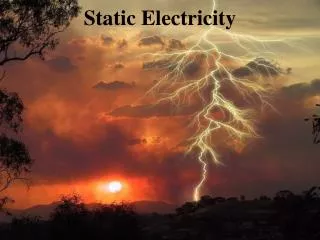
Electric Discharge • Lightning is a very large example or electric discharge • Inquiry Question – Which way does a lightning bolt travel? http://www.youtube.com/watch?v=l9kVA6aY5P8
Using Static Charge • Pick a group of 2-3(max.) • Choose a topic: • Lightning rods (p.g. 418) • Static charge on vehicles (p.g. 419) • Reducing static charge at home & work (p.g. 420) • Spray Painting (p.g. 421) • Photocopying (p.g. 422) • Enviromental Applications (p.g. 423) • Summarize your findings using words & text • Final Round = Static Charge Walk About