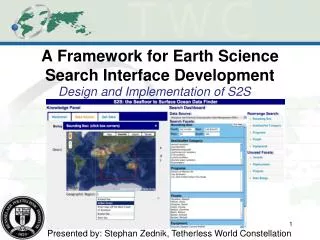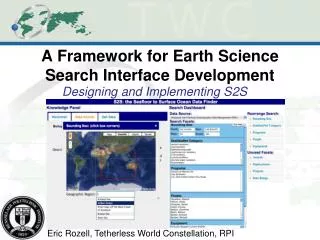
Framework for Earth Science Search Interface Development: Designing S2S for Enhanced Data Access
160 likes | 274 Vues
This document outlines the development and implementation of the S2S framework, designed to enhance the search interface for Earth science data. It details the motivations and use cases that drive the need for a uniform, semantically-annotated web services interface. The architecture of the framework supports reusable UI components (widgets) and encourages compliance with web service standards, enabling better data management and community collaboration. Future work focuses on expanding web service standards, federated search capabilities, and improving usability.


Framework for Earth Science Search Interface Development: Designing S2S for Enhanced Data Access
E N D
Presentation Transcript
A Framework for Earth Science Search Interface Development Designing and Implementing S2S Eric Rozell, Tetherless World Constellation, RPI
Outline • S2S Overview • Motivations & Use Cases • Research & Development Methodology • Framework Architecture • Prototype Implementation • Results & Future Work
S2S Overview • Supports reuse of user interface components (“widgets”) • Uniform search interface for semantically-annotated web services • Applies ontology to describe the application framework
Motivations • Incentivize compliance to web service standards • Assist data management communities in search interface development • Lay foundations for federated search and data integration • Enable community development
Research Methodology Fox et al., 2009
Development Methodology ExView (Maffei et al., 2007) and 4DGeoBrowser (Lerner and Maffei, 2001)
Prototype Implementation Technology: Data Resources:
Results • Extensible Framework • Add web service standards • Add search and analysis widgets • Add data services • Enables community development • Data managers • UI designers • Uniform search interface • Customizable, reusable
Future Work • Implement additional web service standards • e.g., SAWSDL, SPARQL services, OGC standards • S2S as a discovery interface • S2S as a federated search environment • S2S evaluations (usability, extensibility) • VSTO Evaluation Metrics (McGuinness et al., 2007)
References • P. Fox, D. McGuinness, L. Cinquini, P. West, J. Garcia, J. Benedict, and D. Middleton, “Ontology-supported scientific data frameworks: The virtual solar-terrestrial observatory experience,” Computers and Geosciences, vol. 35, no. 4, pp. 724 – 738, 2009. • A. Maffei, S. Lerner, J. Lynch, A. Newhall, K. Fall, C. Sellers, Glenn, "ExView: A Real-time Collaboration Environment for Multi-ship Experiments," OCEANS 2007 - Europe, pp.1-6, 18-21 June 2007. doi: 10.1109/OCEANSE.2007.4302345 • S. Lerner, A. Maffei, “4DGeoBrowser: A Web-Based Data Browser and Server for Accessing and Analyzing Multi-Disciplinary Data”, Woods Hole Oceanographic Institution, Technical Report, WHOI-2001-13, October 2001. • McGuinness, D., Fox, P., Cinquini, L., West, P., Garcia, J., Benedict, J.L., Middleton, D.: The virtual solar-terrestrial observatory: A deployed semantic web application case study for scientific research. In: Proceedings of the Nineteenth Conference on In- novative Applications of Artificial Intelligence (IAAI 2007), Vancouver, BC, Canada (2007)
Research Area • SemWeb Tech. in Web Application Framework design • Distributed Software Frameworks • Cyberinfrastructure • GeoData2011, USGS cyberinfrastructure callout
Research Area • Data Discovery, Use & Integration • S2S currently works as data inventory search • Data discovery involves more sophisticated techniques • Use Case: thermocline in Southern Mariana Trough • Semantic Search • ESIP Discovery Cluster • Widgets for integration & analysis