Understanding Dilations: Transformations in Geometry
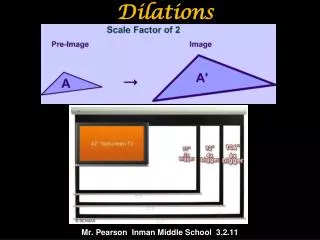
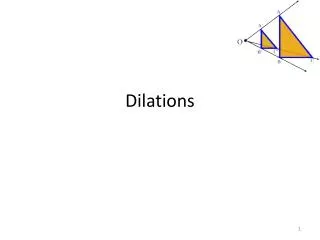
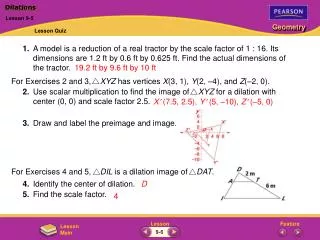
In this lesson on dilations, we explore a transformation characterized by a center point C and a scale factor k, leading to the mapping of points P to P’. We will differentiate between two types of dilations: reductions, where the image is smaller than the original figure, and enlargements, where the image is larger. Students will learn to identify the type of dilation and calculate the scale factor, using proportions to find missing lengths. This foundational concept assists in grasping geometric relationships and transformations.

Understanding Dilations: Transformations in Geometry
E N D
Presentation Transcript
Lesson 7.6 Dilations Pages 393 - 395
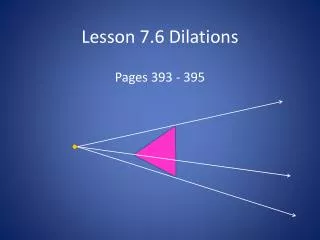
What is a dilation? A dilation is a transformation with center C and scale factor k that maps each point P onto an image point P’. Two Types of Dilations – • Reduction – the image figure is smaller than the original figure • Enlargement – the image figure is larger than the original figure
Tell whether the dilation is a reduction or an enlargement. A’ A A A’ D’ D C C B’ B B B’
Find the scale factor of the dilation.Hint: scale factor for enlargements >1 scale factor for reductions between 0 and 1 C C 3 2 B’ B B B’ 5 5
Use a proportion to find the missing length. 2 x 35 x C C 8 24 20 40
Assignment: 7.6 Worksheet