
Chapter 1 - The Mission and the Method
E N D
Presentation Transcript
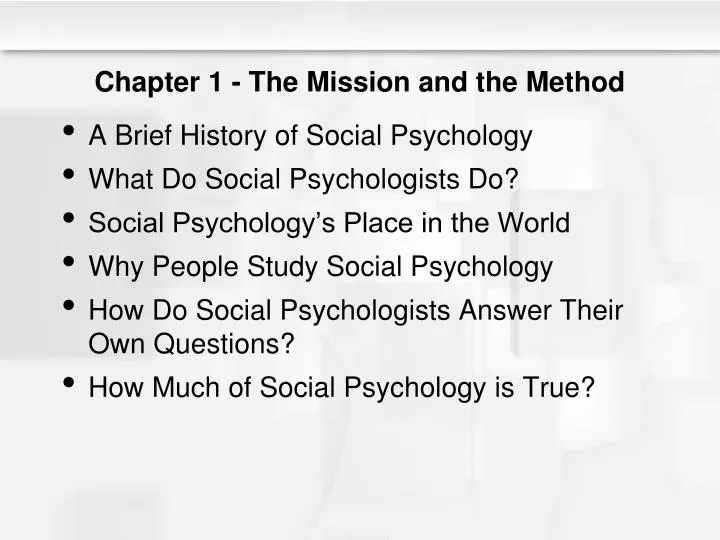
Chapter 1 - The Mission and the Method • A Brief History of Social Psychology • What Do Social Psychologists Do? • Social Psychology’s Place in the World • Why People Study Social Psychology • How Do Social Psychologists Answer Their Own Questions? • How Much of Social Psychology is True?
A Brief History of Social Psychology • Earliest Social Psychology Experiments • Norman Triplett, 1897-1898 • Max Ringelmann, 1880s • Introduction of Textbooks -1908 • Edward Ross (sociologist) • William McDougall (psychologist)
A Brief History of Social Psychology • Influences in Early 20th Century • Gordon Allport • Kurt Lewin • Influences in 1950s and 1960s • Behaviorism • Freudian psychoanalysis • Social Psychology as a Science
What Do Social Psychologists Do? • Broad understanding of how human beings think, act, and feel and the interactions between thinking, acting and feeling • ABC Triad • Personal and Situational Influences on ABC • Use of the Scientific Method
Social Psychology’s Place in the World • Within the Social Sciences • Anthropology • Economics • History • Political Science • Sociology • Psychology
Social Psychology’s Place in the World • Within Psychology • Biological Psychology • Clinical Psychology • Cognitive Psychology • Developmental Psychology • Personality Psychology • Social Psychology
Important Lessons of Social Psy • Power of Situation • Construct Social Reality • Social Intuitions • Outside our Awareness • Attitudes and Dispositions • Application
Research vs. Common Sense • Common Sense • Adages are often contradictory • Poor method of discovering the truth • May be a starting point for questions
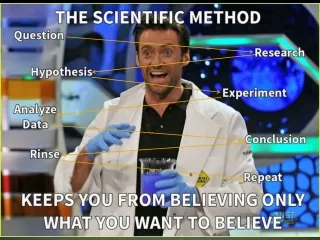
Scientific Method • State problem – Theory • Formulate testable hypothesis • Design study and collect data • Test the hypothesis with the data • Communicate study results
Experimental Research Designs • Experiment • Researcher controls procedures • Participants are randomly assigned into Experimental and Control Groups • Allows for statements of cause and effect • Quasi-experiment • No random assignment
Variables: Independent and Dependent • Independent variable • The “cause” • Manipulated by the experimenter • Dependent variable • The “effect” • Measure as an outcome
Variables • Operational Definition • Does our measure represent the variable? • Construct validity of the Variables • A construct is a abstract, theoretical concept • Does it represent the real variable?
Research Concerns • Extraneous Variables • Other variables that can influence outcome • Confounded – effects of variables cannot be separated. • Internal Validity • Did Independent Variable cause change? • External Validity • Are these results applicable/generalizable?
Experimental Research Designs • Quasi-experiment • No random assignment • Other characteristics of study are similar
Laboratory and Field Experiments • Laboratory Experiments • Experimental realism • Mundane realism • Field Experiments • External validity is • Findings can be generalized
Nonexperimental Studies • Correlational Approach • Variables are not controlled • No random assignment • Correlation • Relationship between two variables • Correlation coefficient • Weakness – does not prove causation