The Rise and Fall of the Byzantine Empire: Culture, Government, and Legacy
The Byzantine Empire emerged as the eastern half of the Roman Empire after Rome's fall in 476 AD. Founded by Emperor Constantine in Constantinople, it thrived under rulers like Justinian, who sought to preserve Roman law and culture. The empire had a centralized government and distinct Christian practices, separate from the Western Church. Despite facing invasions and internal strife, it played a crucial role in preserving Greek and Roman knowledge and facilitating cultural diffusion across its borders. The empire ultimately collapsed in 1453, leaving a lasting legacy on Western civilization.


The Rise and Fall of the Byzantine Empire: Culture, Government, and Legacy
E N D
Presentation Transcript
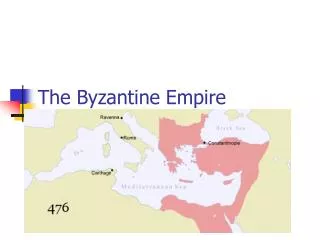
The Byzantine Empire • Fall of Rome – half fall • Civil war ravaged the western half of the Empire, the eastern half of the empire was pretty stable. • So Emperor Constantine decided to create a new capital at the former Greek city of Byzantium, which he renamed Constantinople (present-day Istanbul). • When the western half of the Roman Empire fell in 476, the Eastern half survived and thrived. This Eastern half of the Roman Empire later became known as the Byzantine Empire.
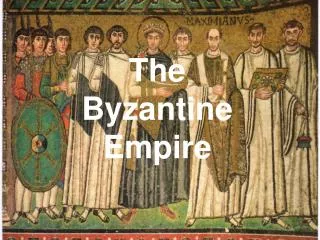
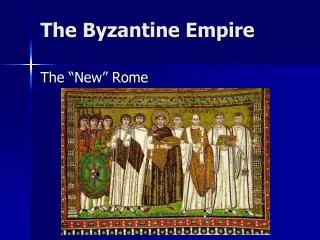
Growth of Empire • Emperors wanted the glory of Rome to live on. Emperor Justinian led the revival • Justinian Code • Theodora • Belisarius • Greek Fire • What kind of Government do you think the Byzantine Empire had?
Government • Centralized government • Political power • Social power • Economic Power
Christian Church • Byzantine’s did not recognize pope’s power like in the West. • Icons • Iconoclast Controversy • Heresy • Excommunication • Eastern Orthodox Church
Culture • Constantinople • Center for trade/spreading of ideas • Scholars served to preserve much of the Greek and Roman advancements and teachings • Cyril and Methodius • Mosaics • Hagia Sophia
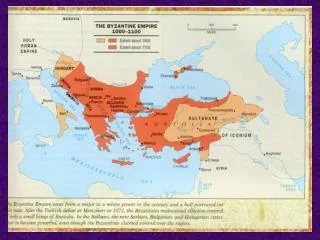
Decline of the Byzantine Empire • Invasions and wars after Justinian died in 565 A.D. • Seljuk turks invaded • The Byzantine Empire finally collapsed in 1453 due to invasions by the Ottomans, but fortunately by that time it had served its important function as a bridge to the past and to the achievements of the Muslims
Recap • The Byzantine Empire served two very important historical functions: • Preservation of Roman and Greek Culture - When the Roman Empire in the West collapsed in 476, many libraries and places of learning were destroyed in the chaos and much of the knowledge that had been gained under the Greek and Roman civilizations was lost. However the eastern half of the Roman Empire, the Byzantine, survived. As a result the Byzantine served to preserve much of the Greek and Roman advancements for Western Europe. Most significant was the preservation of Roman law by Emperor Justinian, the Byzantine's greatest emperor. As a result, these law codes were preserved and have become the basis for the legal systems of many Western countries, like the US. • Cultural Diffusion - Not only did the Byzantine help preserve Roman and Greek culture and Christianity but the Empire also spread these ideas to other parts of the world.