Understanding Bonds: Basics, Types, and Savings Opportunities
This presentation provides an in-depth overview of bonds, highlighting what they are and how they function. A bond is essentially an agreement where one party loans money to another in exchange for future repayment with interest. We explore types of bonds, including corporate bonds and savings bonds issued by the U.S. government. The presentation emphasizes the security of savings bonds, their earning potential, and the ownership structure. Perfect for individuals looking to enhance their financial literacy and understand different investing options.

Understanding Bonds: Basics, Types, and Savings Opportunities
E N D
Presentation Transcript
savings bonds (about 62 slides)
BOND Basics First, some
BONDs • A bond is an I.O.U. • Get it? “I owe you”
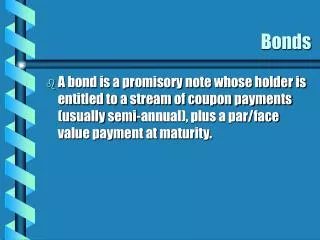
BONDs A bond is an agreement that states that: • one person (or company, or government) • will pay someone else • a certain amount of money • on a certain date.
Bonds are just electronic records nowadays (like money in your bank)
BOND Example You give the Verizon Corporation $1,000 and they give you their 1-year, 5% corporate bond.
BOND Example • You give the Verizon Corporation $1,000 and they give you their 1-year, 5% corporate bond.
BOND Example • You give the Verizon Corporation $1,000 and they give you their 1-year, 5% corporate bond. • 5% of $1000 is $50—you will earn $50 over the next year like this…
BOND Example After six months, Verizon sends you $25
BOND Example After one year, Verizon sends you another $25 plus your original $1000 back
BONDs • A bond is like a loan. • If you lend money to someone (or a company or a government) they pay you the money back later—and they pay you interest too.
Issued by the Federal Government “Issue” a Bond The person (or company or government) who promises to pay later “issues” the bond.
“Issue” a Bond To “issue” a bond means to “send it out” Issued by the Federal Government
Washington, D.C. “Issue” a Bond • Typical “issuers” are: • the Federal Government USA
“Issue” a Bond • Typical “issuers” are: • a State (like the state of California)
“Issue” a Bond • Typical “issuers” are: • a County or a City (like the City of Elk Grove)
“Issue” a Bond • Typical “issuers” are: • a Corporation (like Disney or Kellogg’s)
“Issue” a Bond Typical “issuers” are: Hospitals Airports School Districts Sports Stadiums Government Agencies
Review:typical bond issuers are • The Federal Government • State Governments • Counties or Cities • Corporations • Nearly any large organization that needs money
Why issue a bond? • Issuers need money.
Why issue a bond? • Issuers need money. • Maybe they want to build a highway or a prison
Why issue a bond? • Issuers need money. • Maybe they want to build a highway or a prison They don’t have enough money for that!
Why issue a bond? • Issuers need money.
Why issue a bond? • Issuers need money. • Maybe they want to build a factory or buy a fleet of new trucks.
Why issue a bond? • Issuers need money. • Maybe they want to build a factory or buy a fleet of new trucks. They don’t have enough money for that!
Why issue a bond? • Issuers need money. • Or maybe they want to build a high-rise apartment building.
Why issue a bond? • Issuers need money. • Or maybe they want to build a high-rise apartment building. They don’t have enough money for that!
Why issue a bond? • Issuers need money. • Issuers sell bonds (borrow the money) and pay the interest back with the profit they make later.
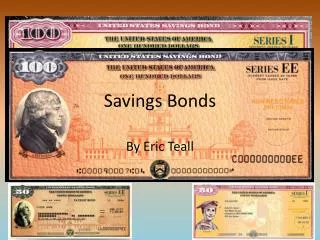
These old bonds are obsolete—they are not sold anymore: Series A Series B Series C Series D Series E Series F Series G Series H Series HH Series J Series K Savings bonds are sold in a “Series”
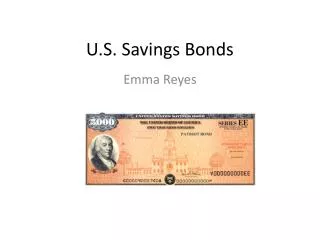
Series I bonds are nicknamed “Inflation” bonds Today, savings bonds are issued in only two types:
Series I bonds are nicknamed “Inflation” bonds Series EE bonds are nicknamed “Patriot” bonds Today, savings bonds are issued in only two types:
Buy a Savings Bond online www.treasurydirect.gov
Savings Bonds are safe • You cannot lose money when you buy a savings bond.
Savings Bonds are safe • You cannot lose money when you buy a savings bond. • The U.S. Government guarantees that you will get your money back with interest.
Savings Bonds are safe • You cannot lose money when you buy a savings bond. • The U.S. Government guarantees that you will get your money back with interest. • “full faith and credit” of the U.S. Government.
It’s got your name on it! Savings Bonds are safe • Registered in your name • Replaced if lost, stolen, or destroyed • Only you can cash in your savings bond • Non-marketable (you cannot sell a savings bond to anyone else, you can only cash it in) Your bond is “registered” to you.
Savings Bonds are safe • It makes no difference who physically holds a savings bond. • The owner of the bond is the person in whose name it is registered, like a car. • You can’t cross out your name and put someone else’s name on it. Never buy a bond from an individual—you will not be the owner.
Earn interest every month • Savings bonds earn (“accrue”) interest every month. • You accrue interest every single month, but you do not receive any interest money until you redeem (“cash in”) your bond.
Redeeming Timeline 1 year 5 years 30 years Buy bond Cannot Redeem Redeem with 3-month interest penalty Redeem without penalty Exception: “Disaster Relief”
Tax on Savings Bond interest • Interest earned on a Federal Savings Bond is exempt from state income tax. State Income Tax • Earn interest every month but don’t pay Federal income tax on that income until bond is redeemed.