Exploring Logarithmic Functions: Asymptotes, Intercepts, and Practical Applications
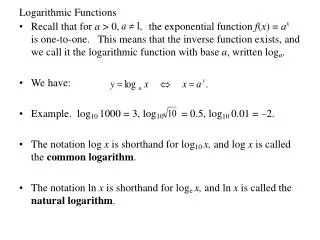
In this lesson, we delve into logarithmic functions, focusing on their graphs and key characteristics. The function f(x) = log_b(ax + c) introduces a vertical asymptote at ax + c = 0. We will explore how to find x-intercepts, y-intercepts, and analyze specific examples like h(x) = log(3x + 10). We’ll also examine real-world applications of logarithms, including sound intensity measured in decibels and earthquake magnitudes on the Richter Scale. Homework will reinforce these concepts through practice problems.

Exploring Logarithmic Functions: Asymptotes, Intercepts, and Practical Applications
E N D
Presentation Transcript
Recall the graphs of y = logbx: f (x) = logbx has the y-axis as its asymptote The y-axis is x = 0, so if we change the function to f (x)= logb(ax + c), then ax + c = 0 is the asymptote. The x-int is found by letting y = 0 & y-int is when x = 0 Ex 1) Find the asymptote and x- & y-int of h(x) = log (3x + 10) asymptote: 3x + 10 = 0 3x = –10 b > 1 0 < b < 1 y-int: y = log (3(0) + 10) y = log (10) 10y = 101 y = 1 x-int: 0 = log (3x + 10) 100 = 3x + 10 1 = 3x + 10 –9 = 3x x = –3 (0, 1) (–3, 0)
We can use our calculators to estimate logs we will round to a typical 4 decimal places. Ex 2) Which is wrong? log 510 = 2.7076 b) ln 70.5 = 4.2556 c) log 0.03 = 1.5229 Change of Base Formula: typically: which is written as (used in calculus a lot!) Ex 3) Calculate log2 7 Half Class: Half Class: both 2.8074
Logarithms are used to model a wide variety of problems. For example, magnitude of sound, Decibels, is where I = intensity of sound & I0 is intensity of the threshold of hearing, which is 10–16 W/cm2 Ex 4) Determine the loudness of each sound to the nearest decibel. a) Whisper: I = 3.16 × 10⁻¹⁵ b) A subway train: I = 5.01 × 10⁻⁷ Another application is the Richter Scale to measure the magnitude of earthquakes. x0 is magnitude of zero-level earthquake w/ reading of 0.001 mm x is seismographic reading of quake
Homework #904 Pg 458 #1–9 odd, 10, 13, 17, 20, 24, 27–29, 32–34, 36, 38, 39, 41, 43–45