Understanding Logarithmic Functions and Their Applications
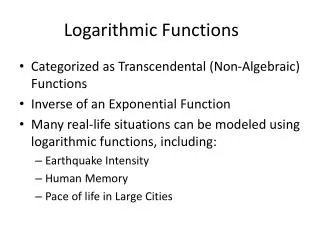
This lesson explores the properties of logarithmic functions, including their one-to-one nature and inverse relationship with exponential functions. It covers important concepts such as domain and range, how to solve logarithmic equations through exponential equivalents, and how to graph these functions. By employing examples, we illustrate the behavior of logarithmic functions with varying bases and highlight common logarithmic bases used in science and engineering. Students will also engage in exercises to reinforce their understanding of logarithmic expressions.

Understanding Logarithmic Functions and Their Applications
E N D
Presentation Transcript
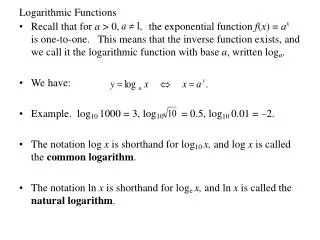
f (x) = bx is one-to-one so it has an inverse. The inverse of an exponential function is called a logarithmic function. For positive real numbers x and b, b > 0 and b ≠ 1, D = x > 0 R = Do “around the world” start with base inverses • D = • R = y > 0 • To solve a logarithmic equation, it is often best to start by changing it to its exponential equivalent. • Ex 1) Solve for x • log7x = 2 • 72 = x • 49 = x c) logx 81 = 4 x4 = 81 x = 3 b)
Ex 2) Graph. Find Domain, Range, x- & y-int, asymptote, inc or dec. a) f (x) = log2x b) • y = log2x • 2y = x • Plug values into y x y x y –2 2–2= ¼ 4 –2 2–1= ½ –1 2 –1 20 = 1 0 1 0 2 21 = 1 ½ 1 22 = 2 4 ¼ 2 D: x > 0, D: x > 0, R: , R: , x-int: (1, 0), y-int: none, x-int: (1, 0), y-int: none, asympt: x = 0, decreasing asympt: x = 0, increasing *Note: For f (x) = logbx if b > 1, f (x) increases if 0 < b < 1, f (x) decreases!
The base of a log function can be any positive number except 1. But, there are two popular & powerful common bases. These have MANY applications to science & engineering (we’ll see tomorrow) Basic Log Facts: (common log) and (natural log) (written as log x) (written as lnx)
Ex 3) Simplify each expression. log6 1 0 (log fact!) log3 81 log3 34 4 lne3 logee3 3 e) undefined why??? d) log10 10–2 –2 f) eln6 eloge6 6
Homework #903 9-3 Logarithmic Functions WS