Understanding Emotional Expressions: Universality, Regulation, and Sincere Recognition
Emotional expressions are observable signs of feelings, revealed through posture, facial expressions, and interactions. This phenomenon supports the universality hypothesis, indicating that emotions such as happiness, sadness, and anger are universally recognized, even among the blind and infants. The role of the amygdala in emotional appraisal and regulation is crucial, affecting how we interpret stimuli. Deceptive expressions like intensification or masking challenge our ability to discern genuine feelings. Understanding these concepts enhances emotional intelligence and interpersonal communication.


Understanding Emotional Expressions: Universality, Regulation, and Sincere Recognition
E N D
Presentation Transcript
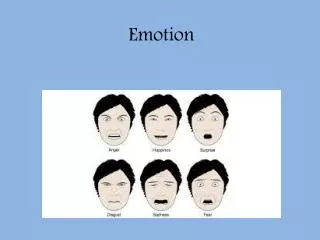
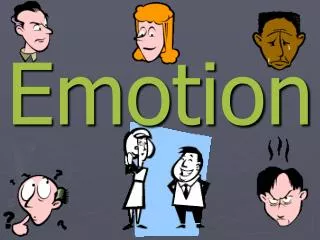
Emotional expression Is an observable sign of an emotional state by observable sign of someone’s posture, gaze, face and how they touch or interact with things When you can see what people are feeling if they were happy, sad, angry, or tired, it is a universality hypothesis, saying that emotional expressions have the same meaning for everyone.
Emotional expressions may be the same for the blind, deaf, and infants. People are often good at recognizing the emotional expressions of other people.
When comparing humans to animals, we make similar face expressions. Such as we are sad, happy, and angry.
The most common expressions that people show are Being happy, angry, sad, tired, and sleepy It takes more muscles to frown then to smile. There 43 muscles that can create over 1,000 of different face configurations establishing your facial emotion.
Emotion Regulation “The cognitive and behavioral strategies people use to influence their own emotional experience.” (Schacter, Gilbert, Wegner 276)
“In 1991, the mayor of Sund, Norway, proposed a resolution to the town council that banned crankiness and required people to be happy and think positively. The resolution contained an exemption for those who had a reason to be unhappy.” (Schacter, Gilbert, Wegner 277)
Reappraisal “Changing one’s emotional experience by changing the meaning of the emotion- eliciting stimulus.” (Schacter, Gilbert, Wegner 277)
The Emotional Brain The structure in the brain called the amygdala plays a vital role in producing emotion, especially in appraisal. Appraisal: an evaluation of the emotion-relevant aspects of a stimulus that is performed by the amygdala.
It’s the amygdala’s job to quickly appraise a stimulus, and requires little information to do so. Information about a stimulus is transmitted simultaneously along two distinct paths in the brain. The faster pathway goes from the thalamus directly to the amygdala. The slower pathway goes from the thalamus, to the cortex, and then the amygdala.
The cortex uses the information to examine the importance and identity of the stimulus. While the cortex examines the stimulus, the amygdala has already received the information and is deciding if the stimulus is potentially harmful. If the amygdala decides that the stimulus is harmful, it begins the neural process to produce fear.
Once the cortex has finished examining the information, it sends a signal to the amygdala telling it to maintain fear or decrease it. .Essentially, the amygdala accelerates emotion, and the cortex reduces emotion. .People with cortical damage have difficultly inhibiting their emotions, and those with damage to their amygdala have difficulty distinguishing between good and bad stimulus.
Deceptive Expression Intensification - To exaggerate an expression Deintensification - Muting the expression of one's emotion
Deceptive Expression Masking - Expressing one emotion while feeling another Neutralizing - Feeling an emotion but expressing no emotion
Determining Sincere Expression Symmetry - sincere expressions tends to be more symmetrical Duration - Shorter or Longer expressions tend to be more insincere, this can be between a half a second and five seconds
Determining Sincere Expression Temporal Patterning - Insincere expressions tend to appear abruptly, while sincere ones appear more smoothly Morphology -certain facial muscles tend to resist conscious control, for example a genuine smile will produce crinkles in the corners of the eye
Test Question True or false – Is Emotional expressions are universal, and have the same meaning for everyone ? Answer: True!
References Slide 1 Schacter, Gilbert, Wegner, Daniel L. Daniel T. Daniel M. Introducing Psychology. New York: Worth Publishers, 2011. 276-277. Print. Slide 4 http://t0.gstatic.com/images?q=tbn:ANd9GcRfcvhLsHWVi0d-o8w_mNZUNvOJekKokZyV4CY16WZWKOpn_PK_18s76d0YKg
References Slide 10 Unable to locate picture source Introducing Psychology pg 281 Slide 11 http://blog.newsok.com/gossip/2009/09/25/american-idol-contestant-2/ Introducing Psychology pg 281 Slide 12 http://cdn.screenrant.com/wp-content/uploads/lie-to-me-season-3-finale.jpg Introducing Psychology pg 282 Slide 13 Introducing Psychology pg 282