Impact of Atmospheric CO2 Decrease on Greenland Glaciation During the Late Pliocene
This study investigates the significant reduction in atmospheric CO2 and its role in the enhancement of Greenland glaciation during the Late Pliocene. The research outlines five main hypotheses explaining Northern Hemisphere glaciation, including the closure of the Panama Seaway, tectonic uplift, the end of 'Permanent El Niño,' CO2 decline, and orbital variations. Findings highlight that atmospheric CO2 decrease was the primary driver of glaciation, while ENSO and tectonic factors played a lesser role. The implications for future ice sheet stability necessitate improvements in CO2 records and transient model simulations.

Impact of Atmospheric CO2 Decrease on Greenland Glaciation During the Late Pliocene
E N D
Presentation Transcript
Atmospheric CO2 decrease led to Greenland glaciation in the Late Pliocene D.J. Lunt, G.L. Foster, A.M. Haywood, E.J. Stone • Motivation • Experimental Design • Results • Conclusions • Future Work / Implications
The Causes of Northern Hemisphere Glaciation? Zachos et al, Nature, 2001
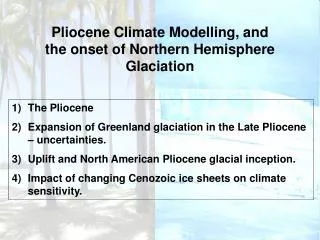
The Causes of Northern Hemisphere Glaciation? 5 main hypotheses • Closure of Panama Seaway • Tectonic Uplift • Termination of ‘Permanent El Nino’ • Decrease in CO2 • Oribital variations
The Causes of Northern Hemisphere Glaciation? 5 main hypotheses • Closure of Panama Seaway • Tectonic Uplift • Termination of ‘Permanent El Nino’ • Decrease in CO2 • Oribital variations Ruddiman, p163
The Causes of Northern Hemisphere Glaciation? 5 main hypotheses Bartoli et al, 2005 • Closure of Panama Seaway • Tectonic Uplift • Termination of ‘Permanent El Nino’ • Decrease in CO2 • Oribital variations
The Causes of Northern Hemisphere Glaciation? 5 main hypotheses • Closure of Panama Seaway • Tectonic Uplift • Termination of ‘Permanent El Nino’ • Decrease in CO2 • Oribital variations
The Causes of Northern Hemisphere Glaciation? 5 main hypotheses • Closure of Panama Seaway • Tectonic Uplift • Termination of ‘Permanent El Nino’ • Decrease in CO2 • Oribital variations Ruddiman and Kutzbach, 1989
The Causes of Northern Hemisphere Glaciation? 5 main hypotheses Japsen and Chalmers, 2000 Parrish et al, 2007 • Closure of Panama Seaway • Tectonic Uplift • Termination of ‘Permanent El Nino’ • Decrease in CO2 • Oribital variations
The Causes of Northern Hemisphere Glaciation? 5 main hypotheses • Closure of Panama Seaway • Tectonic Uplift • Termination of ‘Permanent El Nino’ • Decrease in CO2 • Oribital variations
The Causes of Northern Hemisphere Glaciation? 5 main hypotheses Molnar and Cane, 2002 • Closure of Panama Seaway • Uplift of Rockies • Termination of ‘Permanent El Nino’ • Decrease in CO2 • Oribital variations
The Causes of Northern Hemisphere Glaciation? 5 main hypotheses e.g. Wara et al, 2005 • Closure of Panama Seaway • Uplift of Rockies • Termination of ‘Permanent El Nino’ • Decrease in CO2 • Oribital variations
The Causes of Northern Hemisphere Glaciation? 5 main hypotheses • Closure of Panama Seaway • Uplift of Rockies • Termination of ‘Permanent El Nino’ • Decrease in CO2 • Oribital variations
The Causes of Northern Hemisphere Glaciation? 5 main hypotheses • Closure of Panama Seaway • Uplift of Rockies • Termination of ‘Permanent El Nino’ • Decrease in CO2 • Oribital variations
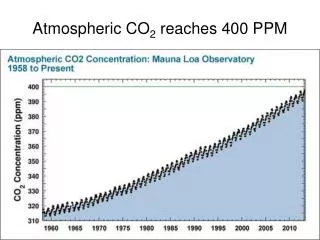
The Causes of Northern Hemisphere Glaciation? 5 main hypotheses 380ppmv mean, 425ppmv max Raymo et al, 1996 • Closure of Panama Seaway • Uplift of Rockies • Termination of ‘Permanent El Nino’ • Decrease in CO2 • Oribital variations
The Causes of Northern Hemisphere Glaciation? 5 main hypotheses 400ppmv to 280ppmv • Closure of Panama Seaway • Uplift of Rockies • Termination of ‘Permanent El Nino’ • Decrease in CO2 • Oribital variations
GCM results… Panama ENSO Rockies CO2 Temp Precip
The Causes of Northern Hemisphere Glaciation? 5 main hypotheses From Berger and Loutre, 1991 • Closure of Panama Seaway • Uplift of Rockies • Termination of ‘Permanent El Nino’ • Decrease in CO2 • Oribital variations
The Causes of Northern Hemisphere Glaciation? 5 main hypotheses Maslin et al, 1998 • Closure of Panama Seaway • Uplift of Rockies • Termination of ‘Permanent El Nino’ • Decrease in CO2 • Oribital variations
The Causes of Northern Hemisphere Glaciation? 5 main hypotheses • Closure of Panama Seaway • Uplift of Rockies • Termination of ‘Permanent El Nino’ • Decrease in CO2 • Oribital variations
Ice sheet model results…(2) Extent of ‘cold orbit’ ice sheet
Conclusions • Enhancement of Greenland glaciation in the late Pliocene driven by decrease in atmospheric CO2 • Greenland ice sheet waxed and waned on orbital timescales prior to 3 Ma. • ENSO and tectonic forcing factors, with or without orbital trigger, did not play an important role in Greenland glaciation. Future Work / Implications • Improvement of CO2 records of the pre-ice core era. • Improvement of IRD records in North Atlantic (including provenance). • Need for transient model simulations (using fully coupled Earth System Models). • Strong dependence on CO2 has obvious implications for future ice sheet stability.