Combinations
This lesson focuses on solving combination percentage problems that often arise in everyday situations, such as calculating tax and tips after discounts. We will explore how to apply multiple percentages sequentially without adding them together. Through practical examples, such as calculating the final price of a discounted car including tax, determining the total bill at a restaurant including a tip, and figuring out the final price of items with multiple discounts, learners will gain a solid understanding of how to correctly manage these calculations.


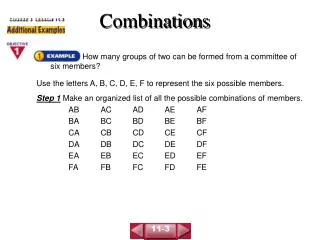
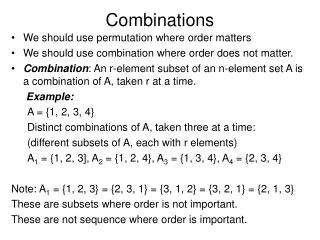
Combinations
E N D
Presentation Transcript
Combinations Mrs. Kuznia Math 8 Day 15
Rule • Sometimes, we have to apply more than one percent to a given problem. • IE: Tax, then tip • Sale price, than tax
Rule Continues • NO MATTER WHAT….NEVER add the percents together. • To do combination problems, you must apply the first percent, then apply the second. • IE, Find the sale price first, THAN add the tax to it.
Example • You buy a $3500 Used car, that has been discounted 10%, but you must pay tax of 8%.What is the total amount you pay?
Example • You got to Fresno’s and your bill comes to $37.50. You must pay and 4% tax, then leave an 8% tip. What is the total amount you pay?
Example • You buy new DVD for $29.99. It is on sale 15% off, and you must pay 8.25% tax. How much do you pay?
Example • You shop at JC Penny’s and you buy a pair or pants for $34.99, that is on sale 30% off. You also have a coupon that gives you an extra 15% off. How much do you pay?