Schedule Update and Quiz Instructions for Teaching Evaluations and Business Strategy Review
This communication provides essential updates regarding class schedules during Dead Week, including the cancellation of Wednesday and Thursday meetings. Please note that Quiz 4 will be available online from 10 AM on June 4 to 5 PM on June 8, covering Chapters 11, 12, and 13. Detailed instructions for Quiz 4 are provided, with multiple-choice and essay questions randomly assigned. Additionally, we discuss business strategy insights from Whole Foods, Jet Blue, Apple, Adidas, Starbucks, Monsanto, and Kimpton Hotels, highlighting their competitive approaches and ongoing challenges.

Schedule Update and Quiz Instructions for Teaching Evaluations and Business Strategy Review
E N D
Presentation Transcript
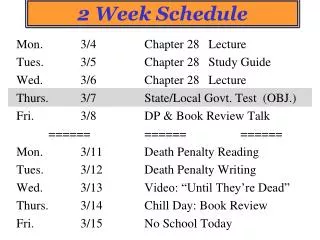
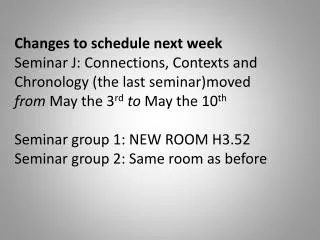
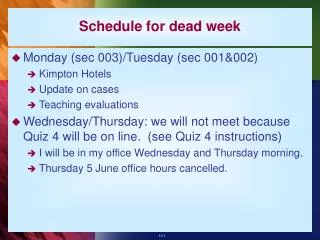
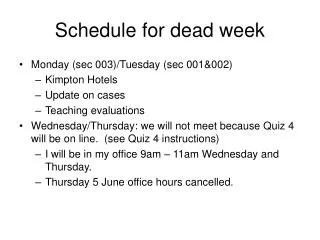
Schedule for dead week • Monday (sec 003)/Tuesday (sec 001&002) • Kimpton Hotels • Update on cases • Teaching evaluations • Wednesday/Thursday: we will not meet because Quiz 4 will be on line. (see Quiz 4 instructions) • I will be in my office 9am – 11am Wednesday and Thursday. • Thursday 5 June office hours cancelled.
QUIZ 4 Instructions • Quiz • Chapters 11, 12, & 13 • 15 multiple choice and 5 short essay questions • Questions are randomly drawn. • 45 minutes • On line (Blackboard) • Available 10am Wed 4 June to 5pm Sun 8 June • We will check: 9am Thursday and 10:00am Friday. • No make-ups. Length of time available should be sufficient.
Fig. 4.1: Identifying the Components ofa Single-Business Company’s Strategy
Whole Foods • Focused differentiation in a fragmented industry • Positioned as a retailer of wholesome, natural, organic goods for home consumption • Question: Were owners passionate about the product or did they see an opening?
Whole Foods • Issue: Ability to manage growth? • Ranked among the 100 best companies to work for by Fortune (8th year in a row) • Improved financial performance • Some controversy with acquisition of Wild Oats
Jet Blue • Focused low cost in a mature industry • Limited routes (new airline) • “bring humanity back to air travel” • Low cost operations • Describes how this was achieved through leadership and management style, human resources, use of technology
Jet Blue • In 2005, highest ranked airline in quality ratings scores: • denied boarding lowest, customer complaints second best (to Southwest), • on-time performance dropped, • mishandled baggage rate still best but deteriorated (4.06 per 1000 passengers). • Higher revenue passenger miles but lost money in 2005. • Slowed expansion as fuel costs rose and encountered string of quarterly losses • Lufthansa acquired 19% stake??
Apple • Broader differentiation through diversification in high tech sector • Describes launch of the iPod and entry into MP3 business • Complement to the computer business • Example of how a company struggles through ownership, leadership changes, and failed products, as it brings out winners
Apple • Continues to expand services available in iPod through iTunes, e.g. MTV products, Nikelodeon, etc, • 1gig iPod nano at $149 • iPhone • In 2006, • Unveiled Mac mini with Intel Dual core • Boot Camp – allows Intel-based Macs to run Windows XP
adidas • Broad differentiation in an industry dominated by few players • “best portfolio of sports brands in the world” • Diversification through acquisition (Salomon) • Restructuring through divestment of Salomon and acquisition of Reebock
adidas • After restructuring • Net income rose from $80.3 b in 2004 to $80.4b in 2005 primarily due to expected demand for World Cup products • TaylorMade-adidas Golf experienced 12% sales increase • Consolidate Reebock in its financial reporting
Starbucks • Focused differentiation and chaining in a fragmented industry • Characteristics of a fragmented industry • Advantages as a chain • Vision of owners • Development of idea • Execution through people, e.g. training, incentives and compensation, systems, etc.
Starbucks • Issue was prospects of continued growth • As at 2006, • record results with revenues up 22% • number of stores 11,225 (up from 10,241 in 2005) • In 2007, started advertising as revenue growth was lackluster.
Monsanto • Classic ethical case. • This is an example of technology providing opportunities while creating risks to stakeholders that may be difficult to quantify. • Also an example of complex issues of intellectual property protection.
Monsanto • Percy Schmeiser continues to be a thorn in Monsanto’s side - • Since he is prohibited from growing GMO canola, he requested Monsanto to remove the unwanted plants. • Since he would not agree to Monsanto’s terms, i.e. release from lawsuits, he did it himself and invoiced Monsanto.
Kimpton Hotels • Focused differentiation in a fragmented industry. • Themed properties, owned by the company, providing service to discerning customers • Execution decentralized organizational structure (e.g. autonomous GMs)
Kimpton Hotels • How does a specific initiative, EarthCare, fit overall strategy • Proceed with Phase II, particularly organic linens? • As of Oct 2005, implementing Phase II but with challenges, particularly organic linen. • Considering subsidizing products that cost more with cost savings generated through water, energy, and waste reduction initiatives.
Kimpton Hotels • Kimpton EarthCare is now organization-wide • Cleaning supplies: all rooms • Soy Inks: All corporate communications use soy based ink • Organic beverages: all complimentary lobby coffee is organic • Towel/Linen Reuse • Energy Conservation: back of the house retrofitted and audited
Kimpton Hotels • EarthCare metrics • Waste reduction • Energy and water usage • Kilowatt hours and gallons • Increase employee retention and morale through this sense of purpose at work