SlideServe
Menu
Préférences
© SlideServe · v2026

Advanced Transducer Technology for Machinery Monitoring

demetrius-martinez avatar
2 diapositives · 117 Views · Nov 17, 2014

BMT in Energy and Environment solves structural problems with critical parameter measurements for performance improvement using strain gauges, accelerometers, pressure sensors, and more. Telemetry enables data collection for various applications. Discover how these technologies can enhance engineering solutions. Typical applications range from face shovels to conveyor drives, with customized equipment for extreme conditions. Data analysis assists in equipment fitness evaluation, hydraulic system understanding, load determination, stress comparison, and design improvement.
Advanced Transducer Technology for Machinery Monitoring - slide 1
01 / 2Advanced Transducer Technology for Machinery Monitoring
1 / 17

Télécharger la présentation

Advanced Transducer Technology for Machinery Monitoring
Une image / un lien ci-dessous est fourni (tel quel) pour télécharger la présentation

Politique de téléchargement : le contenu du site vous est fourni TEL QUEL pour votre information et votre usage personnel ; il ne peut être vendu, concédé sous licence ni partagé sur d’autres sites sans l’accord de son auteur.Le contenu vous est fourni TEL QUEL, pour votre information et votre usage personnel uniquement. Téléchargez la présentation en cliquant sur ce lien. Lors du téléchargement, si vous ne parvenez pas à télécharger une présentation, l’éditeur a peut-être supprimé le fichier de son serveur.Pendant le téléchargement, si vous ne parvenez pas à obtenir une présentation, le fichier a peut-être été supprimé par l’éditeur.

F I N

Plus de contenu associé

Transcription de la présentation
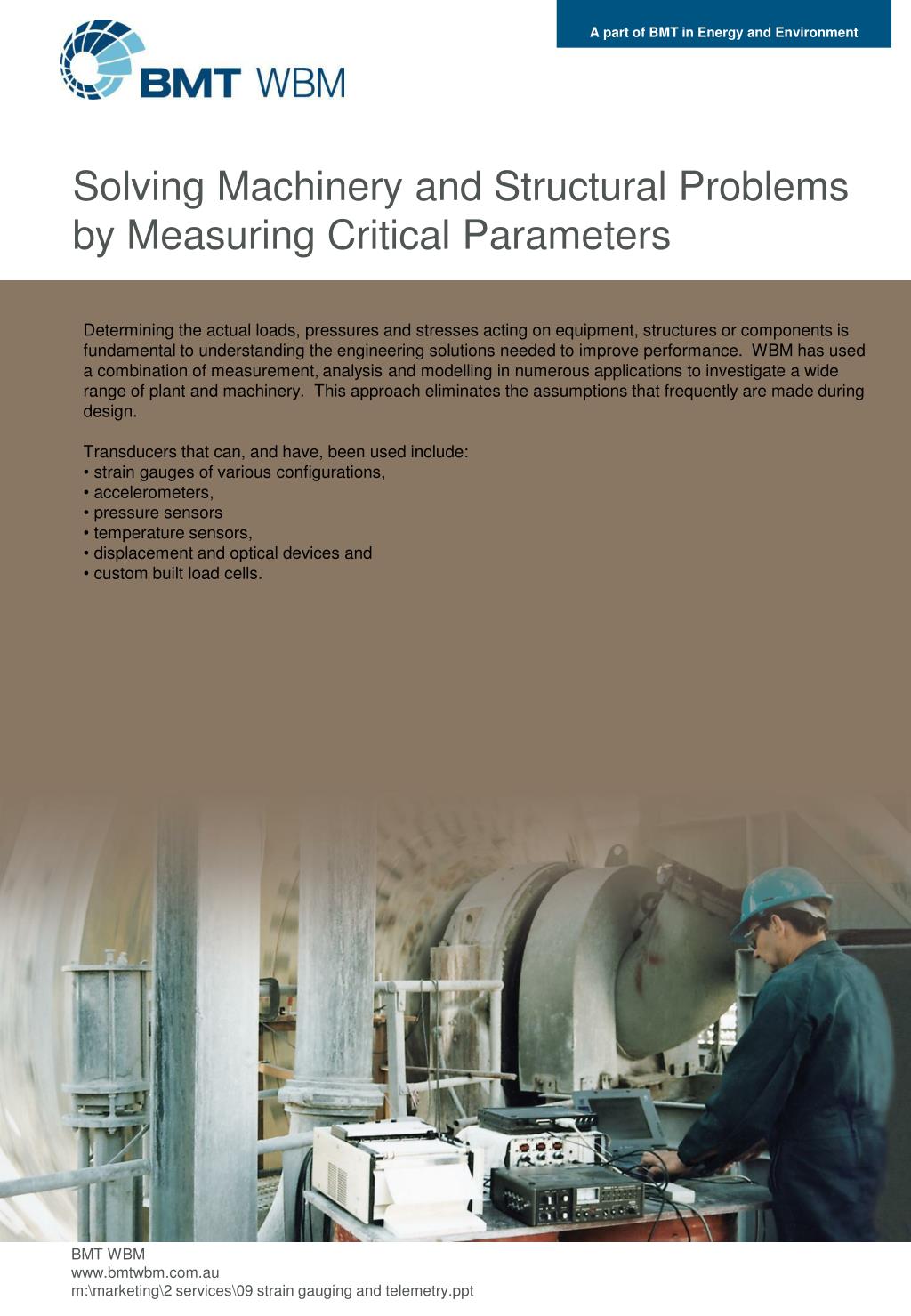
  1. A part of BMT in Energy and Environment Solving Machinery and Structural Problems by Measuring Critical Parameters • Determining the actual loads, pressures and stresses acting on equipment, structures or components is fundamental to understanding the engineering solutions needed to improve performance. WBM has used a combination of measurement, analysis and modelling in numerous applications to investigate a wide range of plant and machinery. This approach eliminates the assumptions that frequently are made during design. • Transducers that can, and have, been used include: • strain gauges of various configurations, • accelerometers, • pressure sensors • temperature sensors, • displacement and optical devices and • custom built load cells. BMT WBMwww.bmtwbm.com.aum:\marketing\2 services\09 strain gauging and telemetry.ppt

  2. The output from these transducers has to be recorded for data analysis and this can be done using a range of tape and chart recorders as well as computer based data logging instrumentation. Installation of these monitoring systems may be for short or long term studies using dedicated equipment or the client’s existing technology. WBM is able to measure up to 256 channels of information simultaneously. Telemetry enables WBM to measure data from moving machinery to determine parameters such as: shaft torque, slew bearing loads or stresses in grinding mills and breakers. Typical applications include: Face shovels, draglines, container cranes, ball mills, fork lifts, dredges, sluice gates, paper mills, rail cars, rail bogies, locomotives, hydraulic presses underground shearers, hydraulic drives, apron feeders, luffing booms, underground roof supports, vibrating screens, wash plant structures, centrifuges, furnaces, smelters and conveyor drives. Some of these installations have involved measurement underwater, at high temperatures up to 400C, work in sub-zero conditions and testing underground to depths of 2000m. In many instances equipment has been customised to suit particular conditions and the parameters requiring measurement. The data collected has been used for a vast range of purposes including: determining the fitness-for-purpose of equipment for strength and fatigue, understanding the behaviour of hydraulic control system on an apron feeder (following a fatal accident), troubleshooting the hydraulics on colliery roof supports, determining loads on a container crane, comparing the stresses on a dragline due to different buckets, quantifying the dynamics on a train for performance specification criteria, improving design or redesign options to meet specified life requirements. These technologies can provide a powerful means of providing engineering solutions to complex issues.