Similarity
This lesson explores the concept of similar polygons, focusing on the equal ratios of corresponding sides and the congruence of corresponding angles. It introduces dilation and reduction as methods of creating similar figures by enlarging or shrinking polygons. Key examples illustrate the relationship between corresponding angles and sides in similar triangles, using theorems to find missing side lengths and the ratio of perimeters. Through interactive exercises, students will strengthen their understanding of similarity in geometry.

Similarity
E N D
Presentation Transcript
Similarity Lesson 8.2
Definition: Similar polygons are polygons in which: The ratios of the measures of corresponding sides are equal. Corresponding angles are congruent.
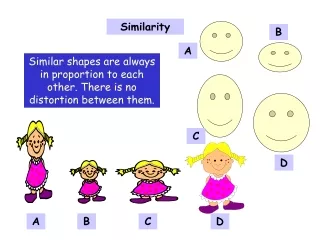
Similar figures: figures that have the same shape but not necessarily the same size. Dilation: when a figure is enlarged to be similar to another figure. Reduction: when a figure is made smaller it also produces similar figures.
Proving shapes similar: Similar shapes will have the ratio of all corresponding sides equal. Similar shapes will have all pairs of corresponding angles congruent.
Example: ∆ABC ~ ∆DEF D A 8 12 4 6 B C E F 5 10 Therefore: A corresponds to D, B corresponds to E, and C corresponds to F. The ratios of the measures of all pairs of corresponding sides are equal. = = =
Each pair of corresponding angles are congruent. <B <E <A <D <C <F
∆MCN is a dilation of ∆MED, with an enlargement ratio of 2:1 for each pair of corresponding sides. Find the lengths of the sides of ∆MCN. (0,8) C 8 MC = MN = CN = (0,4) E 6 10 D N M (0,0) (3,0) (6,0)
Given: ABCD ~ EFGH, with measures shown. 1. Find FG, GH, and EH. FG = GH = EH = 6 B 6 F 9 4 A 4.5 A E C 7 3 D G 10.5 H PABCD = 20PEFGH = 30 = 2 3 2. Find the ratio of the perimeter of ABCD to the perimeter of EFGH.
Theorem 61: The ratio of the perimeters of two similar polygons equals the ratio of any pair of corresponding sides.
Given that ∆JHK ~ ∆POM, H = 90, J = 40, mM = x+5, and mO = y, find the values of x and y. First draw and identify corresponding angles. K M J P O H <J comp. <K <K = 50 <K = <M 50 = x + 5 45 = x <H = <O 90 = y 180 = y
Given ∆BAT ~ ∆DOTOT = 15, BT = 12, TD = 9 Find the value of x(AO). A x AT = BTOT TD O 15 x + 15 = 12 15 9 D x = 5 B 12 9 T Hint: set up and use Means-Extremes Product Theorem.