Understanding Similar Polygons and Their Properties
This chapter covers the concept of similar polygons, defined by congruent corresponding angles and proportional side lengths. It provides notation for similarity within geometric figures, examples including congruency checks, and calculating scale factors. The chapter further explores the relationships between perimeters of similar polygons and how to prove triangles are similar using criteria such as AA, SSS, and SAS. Indirect measurement using similar triangles is also discussed, along with the Triangle Proportionality Theorem and its converse.


Understanding Similar Polygons and Their Properties
E N D
Presentation Transcript
Similarity Chapter 6
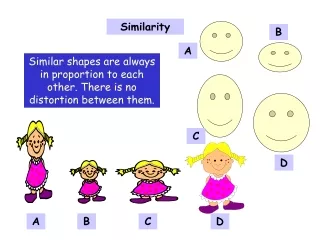
6.1 – Use Similar Polygons • Similar Polygons • Two polygons are similar if corresponding angles are congruent and corresponding sides length are proportional • Notation used is a tilde ( ~ ) • Example 1: • ΔRST ~ ΔXYZ • RS=20, ST=30, TR=25 XY=12, YZ=18, ZX=15 • List all pairs of congruent angles • Check that the ratios of corresponding side lengths are equal • Write the ratios of the corresponding side lengths in a statement of proportionality
Scale Factor • Statement of proportionality • Any pair of ratios form a true proportion • Scale factor • Ratio of the lengths of two corresponding sides of two similar polygons • Example 3 • ΔDEF ~ ΔMNP • Find the value of x • GP #2-3, page 359
Perimeters • Ratio of lengths in similar polygons is the same as the scale factor, this is also true for the perimeters of the polygons • Theorem 6.1 – Perimeters of Similar Polygons • If two polygons are similar, then the ratio of their perimeters is equal to the ratios of their corresponding side lengths • If
Example 4 • A town is building a new swimming pool. An Olympic pool is rectangular with length 50 meters and width 25 meters. The new pool will be similar in shape, but only 40 meters long. • Find the scale factor of the new pool to an Olympic pool • Find the perimeter of an Olympic pool and the new pool • GP #4-6, page 360
6.3 – Prove Triangles Similar by AA • Postulate 22 – Angle-Angle (AA) Similarity Postulate • If two angles of one triangle are congruent to two angles of another triangle, then the two triangles are similar • Example 1 • Example 2
Indirect Measurement • A useful way to find measurements indirectly is by using similar triangles • Example 3 • A flagpole casts a shadow that is 50 feet long. At the same time, a woman standing nearby who is five feet four inches tall casts a shadow that is 40 inches long. • How tall is the flagpole to the nearest foot? GP #4-5, page 377
6.4 – Prove Triangles Similar by SSS and SAS • In addition to using congruent corresponding angles, to show that two triangles are similar, you can use proportional corresponding side lengths • Theorem 6.2 – Side-Side-Side (SSS) Similarity Theorem • If the corresponding side lengths of two triangles are proportional, then the triangles are similar • Example 1 • Example 2
SAS Similarity Theorem • Theorem 6.3 – Side-Angle-Side (SAS) Similarity Theorem • If an angle of one triangle is congruent to an angle of a second triangle and the lengths of the sides including these angles are proportional, then the triangles are similar • Example 4 (on board) • Tell what method you would use to show that the triangles are similar GP #1-2, page 383 & #3-4, page 385
6.5 – Use Proportionality Theorems • The Midsegment theorem is a special case of the Triangle Proportionality theorem and its converse • Theorem 6.4 – Triangle Proportionality Theorem • If a line parallel to one side of a triangle intersects the other two sides, then it divides the two sides proportionally
Theorem 6.5 • Theorem 6.5 – Converse of Triangle Proportionality Theorem • If a line divides two sides of a triangle proportionally, then it is parallel to the third side • Example 1 • GP #1-2, page 392
Theorems • Theorem 6.6 • If three parallel lines intersect two transversals, then they divide the transversals proportionally • Theorem 6.7 • If a ray bisects an angle of a triangle, then it divides the opposite side into segments whose lengths are proportional to the lengths of the other two sides
Examples • Example 3 • Example 4 (on board) • Use the given information to find the length of segment RS • GP #3-4, page 393