Understanding Quantum Mechanics: Wave-Particle Duality and Schrödinger’s Equation
60 likes | 203 Vues
This overview explores the intricate relationship between classical physics and quantum mechanics, emphasizing key phenomena such as wave-particle duality and the photoelectric effect. We analyze how electrons around a nucleus behave differently than classical particles and how Schrödinger’s Equation captures these behaviors. The importance of wavefunctions, probability distributions, and operators in quantum mechanics is discussed, alongside the challenges posed by solving differential equations. This content aims to demystify how quantum mechanics operates fundamentally, revealing the probabilistic nature that defines the behavior of particles.


Understanding Quantum Mechanics: Wave-Particle Duality and Schrödinger’s Equation
E N D
Presentation Transcript
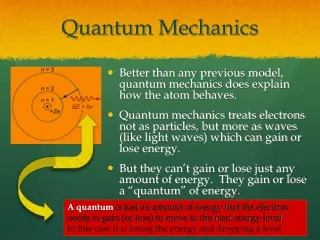
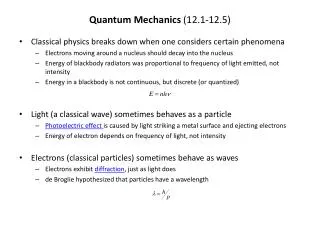
Quantum Mechanics (12.1-12.5) • Classical physics breaks down when one considers certain phenomena • Electrons moving around a nucleus should decay into the nucleus • Energy of blackbody radiators was proportional to frequency of light emitted, not intensity • Energy in a blackbody is not continuous, but discrete (or quantized) • Light (a classical wave) sometimes behaves as a particle • Photoelectric effect is caused by light striking a metal surface and ejecting electrons • Energy of electron depends on frequency of light, not intensity • Electrons (classical particles) sometimes behave as waves • Electrons exhibit diffraction, just as light does • de Broglie hypothesized that particles have a wavelength
Schrödinger’s Equation (13.1-13.3) • Schrödinger’s equation (SE) takes into consideration both the wave and particle nature of a classical particle (or system) • Classical wave equation can be mixed with de Broglie’s equation to give an overall equation for a particle’s (or system’s) energy • SE is a differential equation (DE) and its solution is called the wavefunction of the particle (or system) • All information about a particle (or system) is contained in the wavefunction • The energy of the system (and the form of the wavefunction) is primarily influenced by the potential energy of the system • Difficulty of solving the DE is also dependent on the form of the potential energy • SE is only exactly solvable for a few forms of the potential energy
Properties of Wavefunctions (13.4-13.5) • The wavefunction itself has no physical meaning, but it is critical for understanding how a system behaves • Quantum mechanics deals in probabilities since the wavefunction has wave characteristics, thus a probability distribution function is required • Experimentally determined quantities (e.g., particle position) are influenced by probabilities, so their values are calculated through expectation values • Operators are used to represent some physical quantities (e.g., momentum) • Differential equations often have multiple solutions due to the nature of the boundary conditions • Solutions to the SE are orthogonal