Game Theory
This review delves into the intricacies of simultaneous games through the lens of strategic interactions, particularly focusing on the advertising dilemma faced by tobacco companies in the 1960s and 70s. By modeling player strategies and payoffs, we analyze key concepts such as equilibria, dominant strategies, and the Prisoner’s Dilemma. The discussion extends to real-world applications, illustrating how firms navigate competitive environments, make advertising decisions, and face regulatory pressures. Gaining an understanding of these dynamics is crucial for strategic decision-making.

Game Theory
E N D
Presentation Transcript
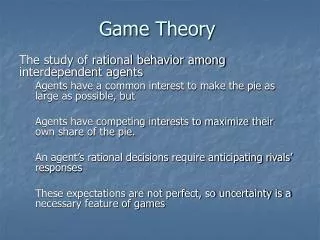
Game Theory Topic 2 Simultaneous Games “Loretta’s driving because I’m drinking and I’m drinking because she’s driving.” - The Lockhorns
Review • Understanding the game • Noting if the rules are flexible • Anticipating our opponents’ reactions • Thinking one step ahead • Where does this lead us? • We’ve defined the “game” but not the outcome
Equilibrium • The likely outcome of a game when rational, strategic agents interact • Each player is playing his or her best strategy given the strategy choices of all other players • No player has incentive to change his or her action unilaterally • Outline: • Model interactions as games • Identify the equilibria • Decide when they are likely to occur
1964 1970 Cigarette Advertising on TV • All US tobacco companies advertised heavily on TV • Surgeon General issues official warning • Cigarette smoking may be hazardous • Cigarette companies fear lawsuits • Government may recover healthcare costs • Companies strike agreement • Carry the warning label and cease TV advertising in exchange for immunity from federal lawsuits.
Strategic Interaction • Players: Reynolds and Philip Morris • Strategies: Advertise or Not Advertise • Payoffs: Companies’ Profits • Environment: • Each firm earns $50 million from its customers • Advertising costs a firm $20 million • Advertising captures $30 million from competitor • How to represent this game?
PAYOFFS Strategic Form of a Game PLAYERS STRATEGIES
What to Do? If you are advising Reynolds, what strategy do you recommend?
Best Replies • A strategy is a best reply to some opponents’ strategy if it does at least as well as any other strategy • si is a best replyto s-i if for every si’
Solving the Game • Best reply for Reynolds: • If Philip Morris advertises: • If Philip Morris does not advertise:
Dominance • A strategy is dominantif it outperforms all other strategies no matter what opposing players do • Games with dominant strategies are easy to solve • No need for “what if …” thinking
Dominance • sistrictly dominates si’ if for every s-i (the payoff is strictly higher for any strategies of the other players) • siweakly dominates si’ if for every s-i, and for some s-i
Dominance • A strategy si is strictly dominatedif some strategy si’ strictly dominates it • A strategy si is the dominant strategy if it strictly dominates all other strategies • A strategy si is weakly dominated if some strategy si’ weakly dominates it • A strategy si is the weakly dominant strategy if it weakly dominates all others
Dominance If you have a dominant strategy, and no ability to agree on an alternate course of action, use it If your opponent has a dominant strategy, and no ability to agree on an alternate course of action, then expect her to play it
Prisoner’s Dilemma Optimal • Both players have a dominant strategy • The equilibrium results in lower payoffs for each player Equilibrium
Prisoner’s Dilemma • Both players have a dominant strategy (s1,s1) u11 > u21u12 > u22 • The equilibrium results in lower payoffs for each player u22 > u11 • The above two statements imply: u12 > u22 >u11 > u21
Cigarette Advertising • After the 1970 agreement: • Cigarette advertising decreased by $63 million • Industry Profits rose by $91 million
Prisoner’s Dilemma • The dominant strategy will be played
How to Win a Bidding War by Bidding Less? • The battle for Federated (1988) • Parent of Bloomingdales • Current share price ≈ $60 • Expected post-takeover share price ≈ $60 • Macy’s offers $70/share • contingent on receiving 50% of the shares • Do you tender your shares to Macy’s?
How to Win a Bidding War (continued) • Robert Campeau bids $74 per share not contingent on amount acquired • Campeau’s Mixed Scheme: • If less than 50% tender their shares, each receives: $74 per share • If more than 50% tender their shares, (if X% tender), each receives:
The Federated Game • To whom do you tender your shares?
How to Win a Bidding War • Each player has a dominant strategy: Tender shares to Campeau • Resulting Price: (½ x 74) + (½ x 60) = $67 • BUT: Macy’s offered $70 !
Dominant Strategies “The biggest, looniest deal ever. ” – Fortune Magazine, July 1988 on Campeau’s acquisition of Federated Stores
Prisoner’s Dilemma Examples • Pricing by Firms • High or low prices? • Value menus and loyalty programs • Divorce • Hire attorneys or proceed amicably? • Nuclear Weapons • Build or don’t build weapons? • State governments • Inducements to attract business to a state
Dominated Strategies • Two restaurants compete • Can charge price of $30, $50, or $60 • Customer base consists of tourists and natives • 600 tourists pick randomly • 400 natives select the lowest price • Marginal costs are $10
Tourists & Natives • Example scenario: • Restaurant 1: $50, Restaurant 2: $60 • Restaurant 1 gets: 300 tourists + 400 natives = 700 customers x ($50-$10) = $28K • Restaurant 2 gets: 300 tourists + 0 natives = 300 customers x ($60-$10) = $15K
Tourists & Natives in thousands of dollars R. 2
Iterated Deletion of Dominated Strategies • Does any player have a dominated strategy? • Eliminate the strictly dominated strategies • Reduce the size of the game • Repeat: Iterate the above procedure
No Dominated Strategies • Often there are no dominated strategies • Some games may have multiple equilibria • Equilibrium selection becomes an issue • Method: For each player, find the best response to every strategy of the other player
Equilibrium • An outcome in which every player is playing a best response to the strategies of all other players. • An equilibriumis a strategy profile s such that si is a best reply to s-i for all i.
Equilibrium Illustration The Lockhorns
Games of Coordination • Complements & technology adoption • Two complementing firms • Must use same technology, but each firm has a preferred technology • Equilibrium does not offer a unique prediction • Commit (or go first) to win! Firm 2
Games of Assurance • Joint research ventures • Each firm may invest $50,000 into an R&D project • Project succeeds only if both invest • If successful, each nets $75,000 Firm 2
Games of Chicken • Entry into small markets Firm 2
The Right Game to Play • Why do we “solve” games? • To know which one to play! • How do internal corporate changes impact the outcome of strategic interaction? • Some games are better than others
Capacity Constraints • Can decreasing others’ added value increase our profits? • Can decreasing total industry value increase our profits?
Multiple Equilibria • What is the predictive power of game theory when there are multiple equilibria? • Sometimes nothing ? • Refinements • Focal points • Efficiency • Evolutionary stability • Fairness • Risk dominance
Summary • Games have predictable outcomes • Notice dominant & dominated strategies • Select the right game to play • Looking ahead: • Sequential Games: How do games unfold over time?