Download
1 / 14
140 likes | 268 Vues
This chapter explores the systematic naming of chemical compounds, specifically focusing on binary compounds comprising metals, nonmetals, and polyatomic ions. It differentiates between Type I (single cation) and Type II (multiple cations) ionic compounds, highlighting naming conventions such as the use of Roman numerals. It also covers the naming of compounds formed by nonmetals and the naming of acids. This structured approach simplifies the identification of over 4 million chemical compounds, making it manageable through standardized nomenclature.

E N D
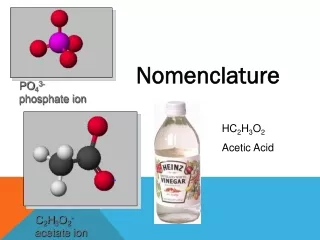
Nomenclature Chapter 4
Nomenclature = Naming • Common names were created before there was a system in place • More than 4 million chemical compounds, memorizing names would be impossible • A system makes it much easier
Binary Compounds • Compounds composed of 2 elements • 2 types • Metal and Nonmetal • Two Nonmetals
4.1 Naming Compounds That Contain a Metal and a Nonmetal • Remember: When metals and nonmetals combine the compound contains ions • Resulting substance is a binary ionic compound • Contain cation and anion in that order • To name them simply name ions • Cation is element name • Anion is root of element name with –ide at end • NaCl is sodium chloride
Certain metal ions form only one cation • Na is always Na+ • Cs is always Cs+ • Ca is always Ca2+ • We will call these Type I cations and they form Type I binary compounds • Other metal ions can form more than one cation • Cr can form Cr2+ or Cr3+ • Lower oxidation number will end in –ous • Higher oxidation number will end in -ic • We will call these Type II cations and they form Type II binary compounds
Type I Binary Ionic Compounds • Cation always named first, anion second • When a single element is the cation we simply use its name • When a single element is the anion take the root and add –ide • Examples • NaI is sodium iodide • CaO is calcium oxide • What would KI be? Potassium iodide • What would CsBr be? Cesium bromide • Do Practice problems on page 87
Type II Binary Ionic Compounds • Need to specify which cation is used • Is it Cr2+ or Cr3+? • We will use Roman Numerals in name • So if it is FeCl2 which Iron is it? Fe2+ (the ferrous ion) or Fe3+ (the ferric ion)? • we know Chlorine has a 1- oxidation number so 2 (1-) = 2-, what must Fe be to cancel this out? • Fe must be 2+ so it is Fe2+ • So name would be Iron II chloride • Table 4.2 page 90
4.2 Binary Compounds That Contain Only Nonmetals (Type III) • Write first element • Write second element • Add prefix to 1st element (but not mono-) • Add prefix to 2nd element • Why do we do this? • NO, N2O5, and NO2 would all be nitrogen oxide under the normal rules • Instead they are Nitrogen monoxide, Dinitrogen pentoxide, and Nitrogen dioxide • one –mono • two - di • three - tri • four - tetra • five - penta • six - hexa • seven - hepta • eight - octa • nine - nona • ten - deca
4.3 Review • Type I • metal and nonmetal • Metal cation has only 1 oxidation number • Type II • Metal and nonmetal • Metal cation has more than 1 oxidation number • Tell which ox. # it is with roman numerals • Type III • Nonmetal and nonmetal • Use prefixes to name
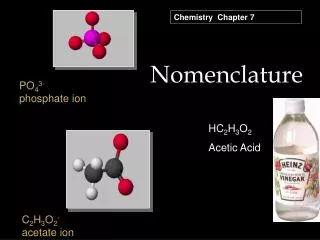
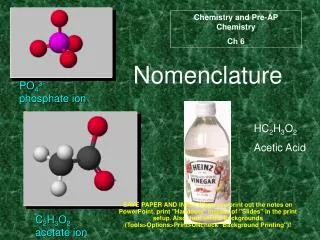
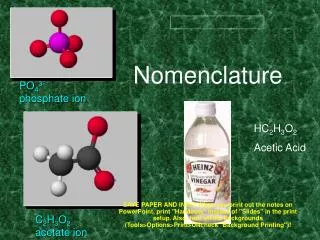
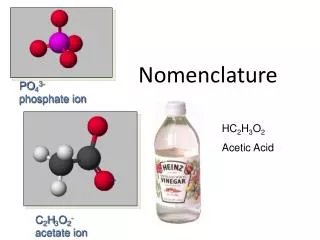
4.4 naming Compounds That Contain Polyatomic Ions • FIRST: Copy Table 4.4 on page 100 into notes • Polyatomic ion – a charged group of atoms bound together • Oxyanion – oxygen and another element • Smallest – hypo- • Lower - -ite (If only 2, smallest) • Higher - - ate (If only 2, largest) • Largest – hyper
When naming compounds with polyatomic ions follow same rules but anion (second part of formula) is a polyatomic ion just name it
4.5 Naming Acids • Acid – produces H+ ions (protons) in water • Tastes sour (not a good test) • It is like a molecule with a H+ attached to an anion • If no oxygen • Hydro- in front, -ic at end • HCl is Hydrochloric acid • If oxygen • Root of central element of anion or anion name with –ic or –ous • Anion ends in –ate then replace with –ic • Anion ends with –ite then replace with -ous
4.6 Writing Formulas From Names • You know how to do this