Understanding Decimal Division Through Multiplication Techniques
In this lesson, you'll discover how to effectively divide decimals by leveraging your knowledge of multiplication. We'll demonstrate that multiplication and division are inverse operations, helping to clarify the process of dividing numbers like 1.6 by 0.2. Through real-world examples, such as calculating how many groups of $0.50 are in $35, you will gain a solid grasp of decimal division. By recognizing patterns and relationships in numbers, you'll be able to confidently solve problems involving division of decimals.

Understanding Decimal Division Through Multiplication Techniques
E N D
Presentation Transcript
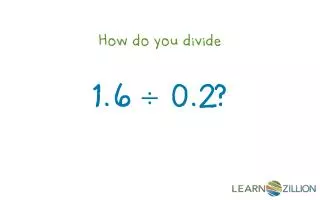
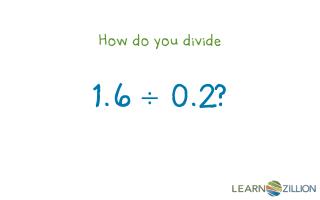
How do you divide 1.6 ÷ 0.2?
In this lesson you will learn how to divide decimals by using your understanding of multiplication.
Multiplication and division are inverse operations. 45 ÷ 9 = n n x 9 = 45 9 x n = 45
Multiplying a number by 10 gives a product that is 10 times as large as the original number. = 1 0.10 = 0.1 0.1 x 10 0.01 x 10 =
Dividing a number by 10 gives a quotient that is 10 times smaller than the original number. 0.01 0. 1 ÷ 10 = 1 ÷ 10 = 0.1
Forgetting to take the decimal into consideration when dividing. 12 ÷ 0.6 ≠ 2
1.6 ÷ 0.2 8 groups of 2 is 16 so 8 groups of 0.2 is 1.6 How many groups of 2 tenths are in 16 tenths? I could count 0.2, 0.4, 0.6, etc. 8x 2 = 16 so 8 x 0.2 = 1.6 1.6 ÷ 0.2 = 8
Jack has $35 and he wants to buy some grapes that cost $.50 a lb. How many pounds of grapes could he buy? How many groups of $0.50 are in $35? I could count $0.50, $1, $1.50, etc. 7 groups of 5 is 35 so 7 groups of $0.50 is $3.50 so 7x $0.50 = $3.50 7 x 5 = 35 70 groups of $0.50 is $35 so 70x $0.50 = $35 $35 ÷ $0.50 = 70
In this lesson you have learned how to divide decimals by using your knowledge of multiplication.
Write an explanation about how you can use what you know about multiplication to solve this problem: 5.2 divided by 0.1.
Write an explanation about how you can use what you know about multiplication to solve this problem: 12.12 divided by 0.12.
Which one of these describes a way to use multiplication to divide 2.1 by 0.3? There are 7 groups of 3 in 21 so there are 7 groups of 0.3 in 2.1. There are 7 groups of 3 in 21 so there are 70 groups of 0.3 in 2.1. C A There are 3 groups of 7 in 21 so there are 3 groups of 0.3 in 2.1. B
Which one of these describes a way to use multiplication to divide 44 by 0.11? There are 4 groups of 11 in 44 so there are 4 groups of 0.11 in 44. There are 4 groups of 11 in 44 so there are 40 groups of 0.11 in 44. C A There are 4 groups of 11 in 44 so there are 400 groups of 0.11 in 44. B