Mysteries of Titan's Methane Lakes: Waves, Winds, and Future Changes
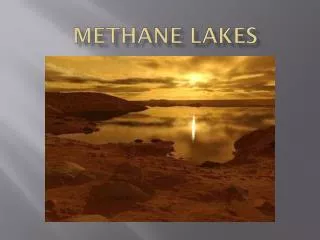
Titan, Saturn's largest moon, features stunning lakes composed mostly of liquid hydrocarbons like methane and ethane, with some larger than Lake Superior. Unique environments around its poles replicate Earth's hydrologic cycle, but the presence of waves remains a mystery. Despite predictions of wind speeds necessary for wave generation, observations from the Cassini mission show no waves down to the millimeter scale. As Titan approaches its north pole solstice, changes could potentially enhance wind speeds, helping unlock the secrets of its methane lakes.

Mysteries of Titan's Methane Lakes: Waves, Winds, and Future Changes
E N D
Presentation Transcript
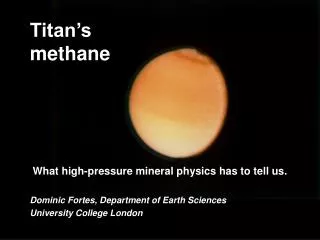
Titan • -290 ᴼ Farenheit • Lakes around poles • Composed of liquid hydrocarbons (methane, ethane) • Some larger than Lake Superior • Follows cycle similar to Earth’s hydrologic • Areas of dried up seas, similar to salt flats
Waves • Sand dunes provide proof for wind • Gravity on Titan 1/7th that of Earth • Predicted necessary wind speeds for wave generation are 0.4-0.7 m/s • Satellite data shows no waves down to mm scale on the lakes (Cassini Solstice Mission) Where are the Waves?
Theories • Lakes are frozen -unlikely due to surface temperatures and presence of rainfall • Thick, tar-like substance present on top • Wind not blowing hard enough -polar winds low during winter (currently)
Future • The North pole of Titan is heading towards it’s solstice in 2017 • Change is predicted to increase wind speeds past threshold for waves • Cassini mission continues to monitor in hopes to explain
References • http://www.clidyn.ethz.ch/papers/HayesWaves2013.pdf • http://lightsinthedark.wordpress.com/2013/07/27/titan-not-windy-enough-for-waves-cassini-will-see-about-that/ • http://saturn.jpl.nasa.gov/mission/flybys/titan20130726/ • http://saturn.jpl.nasa.gov/news/newsreleases/newsrelease20131023/ • http://www.universetoday.com/105706/titans-north-pole-is-loaded-with-lakes/