Introduction to Communication Research
760 likes | 4.08k Vues
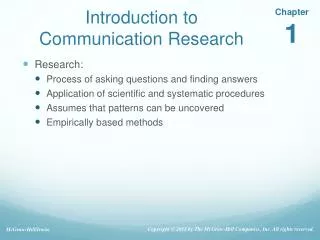
Introduction to Communication Research. Research: Process of asking questions and finding answers Application of scientific and systematic procedures Assumes that patterns can be uncovered Empirically based methods. Your Relationship with Research. Scholarly research


Introduction to Communication Research
E N D
Presentation Transcript
Introduction to Communication Research Research: Process of asking questions and finding answers Application of scientific and systematic procedures Assumes that patterns can be uncovered Empirically based methods
Your Relationship with Research • Scholarly research • You in the role of researcher • You in the role of research consumer • Proprietary research • Commissioned for private use
Scholarly Research • Formal and systematic method • Publicly available • Scientific outcomes • Describes behavior • Determines causes of behavior • Predicts behavior • Explains behavior
Research and Theory • Theory: • Set of concepts, definitions, and propositions that presents a systematic view of the phenomena • Developed and tested over time • Attempts to explain and predict phenomena • Research should be theoretically driven or aid in the creation of theory
Communication as a Social Science • Social science methods • Look for patterns of communication behavior • Empirical • verify through observations or experiences • Focus on messages; effects of messages & their meanings • Quantitative methods • Relies on numerical measurement • Qualitative methods • Researcher is the primary observer
The Scientific Approach • Research follows traditions & procedures • Start with an interesting question • Formulate a hypothesis or research question • Use reason and experience to refine the hypothesis or research question • Conduct the observation, measurement, or experiment • Analyze and interpret the data
Characteristics of Science Based on evidence Testable Explores all possibilities Replicable Public record Self-correcting Measurement and observation Control error Objectivity Skepticism Generalizability Heuristic
Methodological Extremes Methodological tools for different purposes Content of research question or hypothesis drives selection of the methodological tool A method is only useful if it helps answer the research question or hypothesis
Questions Communication Scholars Ask • Wide variety of questions can be asked about many communication phenomena • Determine the significance of the question • Personal interest • Social importance • Theoretical significance • So what?
The Nature of the Questions • Questions of fact • Provide definitions • Questions of variable relations • Examine if, how, and to what degree phenomena are related • Questions of value • Ask for subjective evaluations • Questions of policy • Recommend a course of action