Download
1 / 6
60 likes | 172 Vues
Dive into the core concepts of atoms and the periodic table with this comprehensive review. Learn how to determine the number of protons, neutrons, electrons, and valence electrons, while exploring energy levels and atomic mass. Discover Bohr’s model and the Lewis dot structure for visualizing atomic interactions. This guide also covers the classification of elements on the periodic table, including metals, nonmetals, and metalloids, as well as group names for various element families. Perfect for students preparing for exams or anyone interested in the basics of chemistry. ###

E N D
Atom and Periodic Table Review Chapter 4 and 5
Atom Basics • How do we determine the number of • Protons • Neutrons • Electrons • Valance Electrons • Energy Levels • Look at atomic # • Mass – Atomic # • Look at atomic # • Look at group # • Look at period #
Atom Basics • What does Borh’s model look like? • Center with number of protons and neutrons labels • Rings with dots on them to represent electrons • 1st ring has 2 dots, 2nd ring has 8 dots, 3rd ring has 18 dots • What does a Lewis Dot model look like? • Elements symbol with dots around it to represent the number of VALANCE electrons • Remember put one dot on each side to begin with, only double up with 5 or more electrons.
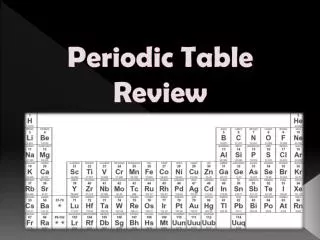
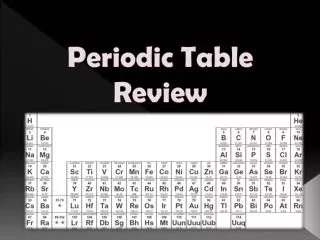
Periodic Table Basics • To the left of the solid stair step line • To the right of the solid stair step line • Sitting on or below the stair step line • Where are the following types of elements located • Metals • Nonmetals • Metalloids
Periodic Table Basics • Group Names N O B L E G A S Alkal I Metal A E L A K R A T L H I N E M E T A L S B O R O N F am i l Y C A R B O N F am i l Y N I T R O G E N F A M I L Y O X Y G E N F A M I L Y H A L O G E N Transition Metals