Comprehensive Review of Key Periodic Table Concepts and Trends
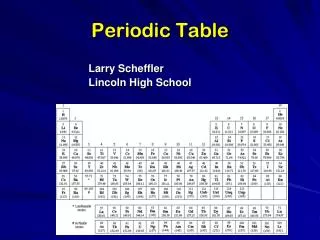
This review covers essential concepts related to the periodic table, including the classification of elements, ion charges, trends in atomic radius, electronegativity, and first ionization energy. It highlights the properties of metals and nonmetals, the arrangement of elements based on atomic number, and the distinctions between groups and periods. Notable references to historical figures in chemistry, such as Dmitri Mendeleev and Henry Moseley, are included. This guide serves as an effective study aid for students preparing for chemistry exams or seeking a deeper understanding of elemental properties and periodic trends.

Comprehensive Review of Key Periodic Table Concepts and Trends
E N D
Presentation Transcript
Ga, Pb, Ge, P, S, Cl, I, He, Xe, UWhich of the above elements is a noble gas? • He, Xe
What is the charge of the following ion: Lead IV • +4 (Roman numeral tells you the positive charge)
What are group 1 elements called? • Alkali Metals
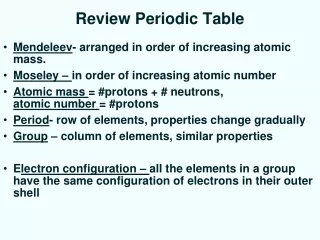
How did HenryMoseley arrange elements on the Periodic Table? • Increasing atomic NUMBER
Place each of the following groups of elements in order of DECREASING atomic radius.Li, O, C, F, N • Li, C, N, O, F
What is the charge of the following ion: sodium • +1 (b/c it is in group 1)
State the group trend (moving top to bottom down the groups) for first ionization energy. • DECREASES
Place each of the following groups of elements in order of DECREASING atomic radius.Mg, Cl, Na, P • Na, Mg, P, Cl
________ is the measure of the ability of an atom in a chemical compound to attract electrons. Electronegativity
Suppose lithium formed an ion. How many electrons and protons does a lithium ion have? • Li+1 (lost 1 e-) • 3protons & 2 electrons
Li, Ca, Y, Mn, Hg, Ga, Pb, Ge, P, S, Which of the above elements is a alkaline earth metal? • Ca
Arrange the following elements in order of decreasingfirst ionization energy: Mg, Ba, Be • Be, Mg, Ba
What group of elements are considered the most stable? • Noble Gases
State the group trend (moving top to bottom down the groups) for electronegativity. • DECREASES
Place each of the following groups of elements in order of DECREASING electronegativity.Po, Se, O • O, Se, Po
_____________ is the energy required to remove an electron from an atom. • first ionization energy
where would you find elements with similar properties? Group or Period • GROUP
Place each of the following groups of elements in order of DECREASING atomic radius.Li, Rb, K, Na • Rb, K, Na, Li
List 4 properties of metals. • Luster • Good conductors of electricity • Ductile • Malleable • High Melting points • Solid, except Hg is a liquid • Lose electrons
State the period trend (moving left to right across the periods) for first ionization energy. • INCREASES
Arrange the following elements in order of decreasingfirst ionization energy: Li, O, C, K, Ne, F • Ne, F, O, C, Li, K
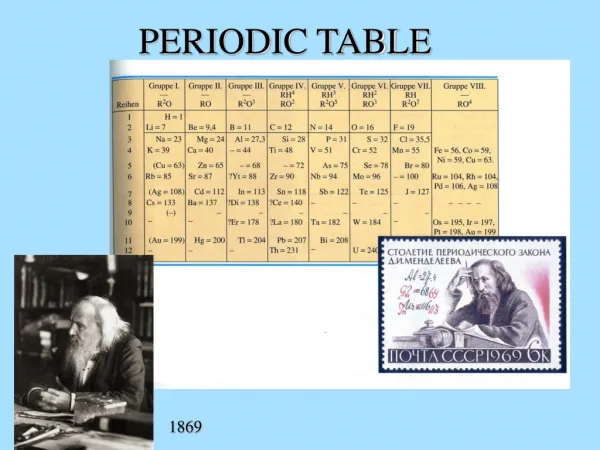
1. How did DmitriMendeleev arrange elements on the Periodic Table? • Increasing atomic MASS
What is the charge of the following ion: bromide • -1 (b/c it is in group 17)
What is the name of the Cl-1 ion? • ChlorIDE
State the period trend (moving left to right across the periods) for atomic radius. • DECREASES
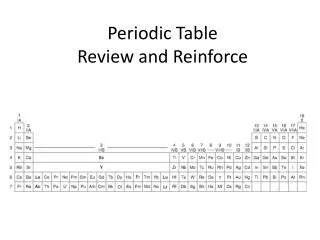
What is the difference between a group and a period? List the number of groups and period. • Group = columns (#1-18) • Periods = rows (#1-7)
How are the elements arranged on the Periodic Table today? • Increasing atomic NUMBER
What is an anion? Explain how they are formed. • Anion = negative ion b/c electron(s) were GAINED
What is the atomic mass of lithium? • 6.941 amu
Where are the most active metals located? • Lower left corner of group 1 (Fr)
The majority of elements in the periodic table are (metals or nonmetals). • Metals
Ga, Pb, Ge, P, S, Cl, I, He, Xe, UWhich of the following is a rare earth metal? • U
What is the charge of the following ion: aluminum • +3 (b/c it is in group 13)
What is the charge of the following ion: magnesium • +2 (b/c it is in group 2)
Arrange the following elements in order of decreasingfirst ionization energy: Li, B, Rb, F, C • F, C, B, Li, Rb
Suppose nitrogen formed an ion. How many electrons and protons does a nitrogen ion have? • N-3 (gains 3e-) • 7 protons & 10electrons
Li, Ca, Y, Mn, Hg, Ga, Pb, Ge, P, S, Cl, I, He, Xe, UWhich of the above elements is a non-metal? • P, S, Cl, He, I, Xe
State the period trend (moving left to right across the periods) for electronegativity. • INCREASES
Where are metalloids used? • Electronics- computers, calculators
Group 17 elements are called? • Halogens
List 4 properties of nonmetals. • No Luster • Not good conductors of electricity • Not Ductile • Not Malleable • Low Melting points • Gain electrons
Place each of the following groups of elements in order of DECREASING electronegativity.Ga, Br, Ra, Ca • Br, Ga, Ca, Ra
Li, Ca, Y, Mn, Hg, Ga, Pb, Ge, P, S, Which of the above elements is an alkali metal? • Li
_____________ is half the distance between the nuclei of identical atoms joined in a molecule. • atomic radius